Monday, 25 March 2019

Un Chien Andalou (Luis Bunuel, 1929)


So, is this a surrealist classic, or truly an Andalusian dog of a film?

This is yet another film that i became aware of at a young age, when it was obliquely referred to by Alan Frank in Horror Films (Hamlyn, 1977) - a tome that was bought for me second hand when i was bedridden with mumps - as the film that closed the first, silent, period of the genre and fantasy cinema but that it was "obscurity... taken by some critics to be the same as profundity".  Therefore, since the age of ten or so, i have always been in something of a dichotomous dilemma over whether or not i ever wanted to see it.  On the one hand, the brief synopses i'd read that went in any way to describing the content of the film - a short series of vignettes containing surrealistic, bizarre and horrific imagery - sounded great; on the other, Mr Frank's and others' opining that it was some kind of 'artsy-fartsy' experiment masquerading as a genre piece was always hovering like a sneering bit of reverse snobbery at the back of my cranium.


Of course, by the time i was a university student, the latter description would actually increase its appeal - me having grown into an artsy-fartsy type myself - and it was no coincidence (or perhaps it was, as it's a damn great record in its own right) that one of my favourite albums since secondary school was the Pixies' Doolittle containing the magnificent slab of noise 'Debaser' with its chorus quoting the title of Un Chien Andalou.  And it would be at a gig by the then newly-reformed Pixies (i can still remember my excitement: who thought that would ever happen?  I'd discovered them shortly after their implosion [my entry level 'album' was their post-mortem compilation Death to the Pixies] and so never dared to dream i'd ever see them live - but there we were in Glasgow's SECC on the 4th of October 2009, when before the band took to the stage the lights dimmed and the 16 monochrome minutes of Un Chien Andalou were projected upon the backdrop wall.  Along time after i'd first read about it, here it was unspooling before me when i was already in a state of anticipation and excitement, and having to shush and wave away the friends around me who were impatient for some rock action.

Written by Salvador Dali and directed by Luis Bunuel (of future Viridiana [1961], The Exterminating Angel [1962] and Belle de Jour [1967] fame), this dog certainly has a fine pedigree.  It opens boldly with one of its most infamous images: a man (a self-insertion cameo by Bunuel himself) calmly sharpening a straight razor before walking out onto a nighttime balcony to watch the full moon - then approaching a young woman (Simone Mareuil - who would later end her life by setting fire to herself in the middle of a town square ["Immolation's what you need, if you wanna be a Record Breaker", as Roy Castle certainly never sang]) before - as a thin wisp of cloud moves across the lunar eye in the sky - slicing her eyeball (actually the eye of a dead calf in extreme close-up, its fur bleached to register as human flesh tone in black and white); the bifurcated orb oozing it's horrid glue.  This scenario was culled fro a discussion between Bunuel and Dali that was the inspiration for the movie: Bunuel having had a dream in which he saw a cloud slicing the moon "like a razor blade slicing an eye".  This determination to chronicle personal nightmares and dreamscapes on film results in the entire piece's ambiguity and random jumps of dream logic akin to August Strindberg's reality-warping plays A Dream Play (1902) and The Ghost Sonata (1908).


What follows is a series of vignettes connected by the strange flow and flux of REM sleep: a young woman (Mareuil) encountering a man (Pierre Batcheff - who would also go on to commit suicide subsequently: in his case a barbiturate overdose) dressed in a nun's habit who is run over whilst cycling in the street.  Taking the box that he is wearing around his neck, she returns home to her apartment and opens it to find his nun's wimple and habit enfolded inside before laying them out upon her bed.  Then the man appears in her room, staring at his own hand from which ants are erupting from a wound in his palm (a future suicide experiencing... formicide?).

Later, when the girl rejects his advances and backs into the corner of the room wielding a tennis racquet to keep him at bay, the man picks up a pair of ropes and proceeds across the room towards her dragging behind him two grand pianos, each containing the rotting corpse of a donkey.  This iconic image was a snook being cocked by Bunuel and Dali towards Spanish author Juan Ramon Jimenez, who had authored a children's book entitled Platero and I about a small boy's relationship with a donkey (no, not in a Clerks II "donkey show" kind of way), which they both apparetly had an enmity towards.  Though i don't think that the man who originated the quote "If they give you lined paper, write the other way" can be all bad.


After further digressions including dissolves from the reclining young woman's armpit hair to a sea anemone (oxters to oysters, perhaps?), murder by doppelganger, a smile quite literally being wiped from the man's face (to by replaced by armpit hair - how Freudian for a fetish to be revealed through filmmaking) and a mysterious and ominous death's head moth, we get the caption "Au Printemps..." to find that in the spring these scar-caused lovers have shed their skin and been blown away on the changing winds to wind up buried in the sand of the beach at Le Havre.  Which is a thing that can happen.


That is textbook enigmatic.

In summary: i agree with Black Francis rather than Alan Frank.  A surrealistic pillow indeed.

Sunday, 10 March 2019

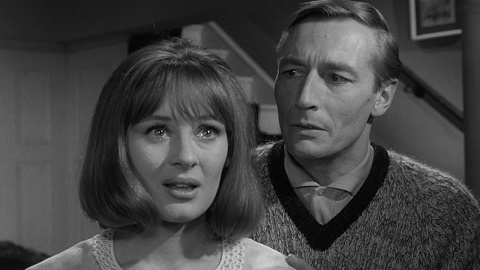
Unearthly Stranger (John Krish, 1963)

"I expect to die - to killed by... something you and I know is here.  Invisible... it moving, unseen, amongst us all each moment of the day and night.  There were times when you thought i was insane, but listen to this tape i beg you - so that you know what it is that you must fight."


Black and white Britain of late 1963 was a good place to find the alien.  Whilst the November of that year spawned a monster in the shape of 'An Unearthly Child', begetting the 55 years and still rising reign of BBC television's Doctor Who, two months earlier - on the big screen, but not in colour - the cinemas had bore witness to an Unearthly Stranger.

Also known as Beyond the Stars, and in Mexico under the title Mujeres de lo Desconocido (Strange Women or Women of the Unknown), the film was distributed by Nat Cohen and Stuart Levy's Anglo-Amalgamated in the UK and James H. Nicholson and Samuel Z. Arkoff's American International Pictures (home at the time to horror mavens Roger Corman and Herman Cohen) in the US.  Filmed at Buckinghamshire's Beaconsfield Film Studios by production company Independent Artists, the film was produced by Julian Wintle - who would go on within the next two years to take over from John Bryce (who had earlier inherited the mantle from Leonard White) as producer of ABC TV's spy-fi telefantasy classic The Avengers.  The cast list also includes Avengers alumni, including Philip Stone (Dr Richard Tredding, co-GP of original Avenger Dr David Keel in the show's earliest episodes, and who would also go on to portray the spectral Mr Grady in Stanley Kubrick's monumental 1980 horror The Shining), Patrick Newell (Mother in the sixth and final Tara King season, as well as Colonel Faraday in the 1976 Doctor Who story 'The Android Invasion') and Warren Mitchell (just about to make the first of his four Avengers appearances in 'The Golden Fleece', which would air in December of 1963), as well as featuring Jean Marsh (three-time Doctor Who guest star - including as doomed companion to the First Doctor Sara Kingdom - as well as memorable childhood-scarring turns as Mombi and Queen Bavmorda in Return to Oz [Walter Murch, 1985] and Willow [Ron Howard, 1988] respectively).


Filmed in atmospheric black and white, the movie begins in media res with the protagonist, Dr Mark Davidson (John Neville, who would go on to go head to head with Jack the Ripper as Sherlock Holmes in James Hill's 1965 A Study in Terror as well as starring as the eponymous Baron Munchausen for Terry Gilliam in 1988 and forming part of the vast conspiracy faced by The X-Files' Mulder and Scully as The Well-Manicured Man) running for his life through the darkened streets of London pursued by some unseen force.  His invisible pursuer effectively conveyed utilising only sound, Davidson holes up in his nighttime-deserted workplace - the Royal Institute for Space Research (doubtless an offshoot of Professor Bernard Quatermass' British Rocket Group) where you begins to record his testament of the things that he has seen (and the horrors unseen of which he has become aware) on his desktop dictaphone, taking us via his terrified reminiscences into the main body of the story.

In flashback we see how Davidson gained his position at the Space Institute after the sudden and mysterious death of his predecessor Professor Munro (Mitchell), whose inexplicable demise is simultaneously being investigated and covered up by Major Clarke (Newell, in a strangely mercurial performance) - to the extent of Munro's corpse being 'disappeared' before Davidson and his coworker Professor Lancaster (Stone) can take a look at it, his unoccupied coffin being weighted with bricks before the funeral.  The project being worked on by the late Munro, and now Davidson and his colleagues, is an audacious plan to circumvent the vast time scales involved in physically traversing the vast interstellar distances by devising a method for a human being to mentally project him or herself through space to another world (shades of Ian Curteis and John Croydon's 1966 The Projected Man, or the Guild Navigators' "travelling without moving" in Frank Herbert's 1965 novel Dune), and it begins to emerge that otherworldly interests are vested in killing this project at birth before mankind can spread out into the cosmos.


At the same time, Davidson has returned home from time away in Switzerland with a new bride, Julie (Gabriella Licudi, who would later play Beryl Stapleton in the BBC two-part adaptation of 'The Hound of the Baskervilles' starring the inestimable Peter Cushing as Holmes), whom he met in strange circumstances.  Taking an interest in meeting his friend's new spouse, Lancaster at first puts her strange air down to her adjustment to life in Britain but notices some strange things about her.  Her lack of blinking extends to sleeping at night with her eyes wide open, which unnerves her husband, and Lancaster takes particular note when he walks into the Davidsons' kitchen to see her lifting a red-hot casserole out of the oven with her bare hands without registering the slightest pain or discomfort.  Julie is, of course, an alien in a very different sense from being Swiss and is the agent who has been assigned to Davidson with orders to prevent his work from proceeding up to and including killing him in the same way that Munro was dealt with (aneurysm via some kind of ray projection - literally exploding his brain).  The alien plan is somewhat complicated by the fact that even as her husband slowly begins to realise her unearthly origins, she has begun to have genuine feelings for him.  Going against her orders, Julie confesses both her true identity and her love for Mark shortly before she vanishes - leaving only her clothing behind like Nessarobe Thropp's shoes.


This is where we catch up with the opening events of the movie, as Davidson is pursued through the twilit avenues of Westminster by the unseen and malevolent alien force that took Julie, and dictates the preceding events in his office.  At this point he is surprised by his loyal secretary Miss Ballard (Marsh), who reveals that she is his pursuer ("We have been here for twenty years") and fully intends to carry out Julie's disobeyed orders be killing him.  Their subsequent life-or-death struggle results in Miss Ballard plummeting from a high window to the streets below, only to also vanish leaving only her apparel by the time Davidson descends to street level, where he is surrounded by the accusing glares of a crowd of eerie non-blinking women - the strange women from the unknown of the Mexican title.

An unusual and unique take on the well-worn theme of alien invasion so beloved of the b-cinema of the 1950s and 1960s, Unearthly Stranger benefits from effective direction and a steadily building atmosphere of paranoia seeping into the gentility of middle class '60s Britain, as well as strong performances from John Neville and Gabriella Licudi in particular.  A neat subversion the hackneyed pulp SF trope of astronauts landing on a "planet of the women": for they are the ones who have come here...

Friday, 8 February 2019

Star Wars - The Force Awakens: A XXX Parody (Dick Bush [?], 2016) [NSFW]

Not safe for work, in a galaxy far, far away...


When Star Wars finally returned (like the proverbial Jedi) to the silver screen in 2015 after a long decade of fandom splitting over the merits and demerits of the prequel trilogy (largely not a fan, i have to admit.  E'en when the prequels were announced back in the early to mid 1990s, my young self thought "Well, that's fine, doing I to III but i want to know what happens next after Episode VI!" - and i stand by that.  And, though much shade and invective has been thrown the way of The Phantom Menace, for me the follow-up [or follow-through, rather, it being filmic faeces in my opinion] Attack of the Clones was a far, far worse cinematic sin) there was bound to be a divided reaction.  For everyone hailing Episode VII as the Second Coming of the Holy Trilogy, restoring the sense of wonder and pure joi de vivre of the first (now, trilogically speaking, second - but you know what i mean) three movies, there were others condemning it as a bland and hollow replay of the 1977 original with little new  content.  I fell somewhere between these two extreme poles of opinion with all the sane people who don't bother recording Youtube videos of themselves ranting in a Bobo Fett mask about how LUCASFILM have KILLED STAR WARS and SOMETHING ANGRY and INCOHERENT about SJWs and RAPE of CHILDHOOD!1!!1!

But mainly, i thought, "This could be sexier".  Thankfully, there are like minded geniuses out there more motivated than me who can actually bring such stuff into existence, and lo, but a year later we had a Porn Parody of Episode VII.  I've long thought that the subgenre of the porn parody is a fascinating area.  Most of them, naturally, are made by people with a genuine love of the subject matter being sexily spoofed and so as well as the carnal content there is more often than not a joy to be had with the knowing winks (checks spelling: yep, that's what i meant to type...) and references.  Filmmakers like Joanna Angel of Burning Angel (whose oeuvre i certainly intent to explore more fully after having tentatively probed it - oo er!) and Dick Bush of Digital Playground - a company whose frequent abbreviation to 'DP' can sometimes cause at least momentary confusion when discussion pornography - and Brazzers certainly manage to do it very well. I even know someone who actually edits out the sex scenes from such films and watches them with his family purely as spoof versions of movies and TV shows.  I found that nigh-on incomprehensible at first, but it does actually work surprisingly well.  Oh, by the way, I am working under the assumption that TFA: XXX is the handiwork of Mr Bush - there's no directorial credit either on the film itself or on IMDB, but it certainly seems like him.


Starring the trousers-meltingly gorgeous Italian-born Stella Cox as Rey - and no slight at all upon the charms and talents of Daisy Ridley, but Ms Cox is possibly the sexiest space babe since Caroline Munro's Stella Starr in Luigi Cozzi's 1978 cash-in classic Starcrash - this 26-minute video vignette begins with our voluptuous vixen infiltrating the First Orders dreaded Death Star III Starkiller Base in order to rescue Finn (uncast and unseen in this short) from the clutches of Kylo Ren and to find the Force deep inside of her" (Hmmm...).  We are informed of all this via the classic Star Wars yellow text scroll, accompanied by a musical score that manages to just about skirt the copyright of John Williams' cues.  We encounter Rey (clad in an at least cosplay-accurate version of her costume) as she jiggles down a corridor staff in hand - by which i mean her actual fighting staff, we'll get to what you're probably thinking in a moment - her bountiful breasts bouncing beautifully.  She then has to get past a bulkhead door, the usual fast-moving "ssshhhh-kkk!" Star Wars door here represented by a pretty slow-moving corrugated garage door.  If it had been this that Harrison Ford had his on-set accident with, i think his leg would have been fine to be honest.


After a brief blaster fight with a group of stormtroopers (with pretty decent digital effects), Rey finds herself facing the black-clad Solo Junior himself, Kylo Ren.  I don't know who the performer is, as he goes uncredited, but he's very good.  The voice is pretty much spot on, even if the costume's mask might look slightly shoddier than his subordinate troopers, and he manages to convey a comically OTT version (which only takes a bit of slight exaggeration to be fair) of Adam Driver's mardy Darksider.  After Rey is swiftly incapacitated by Kylo's canon trademark "knock out with a wave of the hand" date rape ability, she awakens in leather restraints (Mmm) and trussed up in what looks suspiciously like medical stirrups - lending the already implicit/explicit (delete as per headcanon) rape threat of the original Kylo/Rey interrogation scene a distinct gynaecological edge.  When his attempted (mental, rather than physical) probing of our heroine fails to get him anywhere, the Dark Lord of the Strop flounces out in a gargantuan huff, leaving orers for the stormtrooper guard to carry on guarding (insert Sid James "Hyah hyah hyah!" dirty laugh here) but not to engage with the prisoner.  In The Force Awakens of course the guard is played by James Bond 007 himself, Daniel Craig, in a cameo - here we get veteran swordsman (lightsabre-man may be more appropriate here, i suppose) Danny D, adding to his CV which already contains mucky homages including portrayals of Sherlock Holmes, Victor Frankenstein and the titular (no, not in a Jodie Whittaker kind of way) Time Lord the Doctor of Doctor Who.  Unlike EoN Productions' Dan, our man Dan gets his head well and truly  turned by the ravishing Rey in order to follow more detailed instructions than simply releasing her from her restraints.  Not that it should take the powers of a binding universal energy field to compel anybody to follow the lovely Stella's commands.


As the tumescent trooper (who's character isn't given a name: let's go with a Finn/FN-2187 stle D-AN4L, that seems appropriate) fondles Rey's boobage at her beck and call, we have the comical sight of Kylo Ren, seen through the window of the cell behind out stars, taking out his petulant pent-up fury on another henchman by beating a guard to the ground and repeatedly kicking him when he's down.  It's all perfectly in-character and very funny, while Rey continues issuing Force-powered orders such as "Now, take your helmet off, and go down and lick my pussy", "You will express pleasure as you feel it" and "You will let me suck your cock" - none of which, from Ms Cox, should need any sort of cosmic compulsion to utterly obey.  Still, obviously there's no other option for him but to let her slurp upon his schlong - who needs telling twice to let top totty take it in their hungry mouths?  This then, quite naturally, leads to some pretty deep fucking, her legs slung up on his shoulder as he grips her by the throat (choke-fucking, rather than Force-choking: an ability that i find myself wishing the player characters on MMPORGs like  KOTOR [if you can understand the acronyms, congratulations: you're  a fan] had) whilst performing a deep probe.  Who needs probe droids?

A slight adjustment to cross the perineum (a run that i'd certainly make in less than twelve parsecs) and Danny has switched from the light side to the backside, before turning her over to thoroughly plough her anal furrow from behind.  The lass clearly likes it in her Jakku jacksie, taking D-AN4L's considerable length with her arms pinned behind her back and gasping "I can feel the Force!  Oh my God, i can feel it!"  I knew that the Force could be found by searching inside oneself, but i didn't know that its precise location was up the rectal fundament. It certainly seems that he's found her F-spot, anyway.  We then get another brief session of pussy fucking, as she playfully dons his stormtrooper helmet whilst taking his helmet, before the lucky sod gets the privilege of sliding his shaft between her chesticles for a titwank after which be blows his midichlorians all over her tits, stomach and pudendum.  Only imperial stormtroopers are so precise.


Rey readjusts her costume as she leaves, leaving the dazed trooper behind as she continues her quest to locate her friend.  Kylo Ren returns to find his hapless yet satisfied guard unable to provide a satisfactory explanation for his prisoner escaping and so Force-throws him into the wall (achieved by the low-tech but effective method of Danny hurling himself backwards into the bulkhead.  The magic of acting), and proceeds to have another tantrum, slashing the walls furiously with his cross-bladed lightsabre - during which another trooper executes a perfect "NOPE!" gif-worthy manouvre of walking in, seeing what's occurring, and promptly turning on his heel to walk straight back out.  Very wise.

All in all, a fun mix of science fantasy, fucking and frollicking that should entertain any geeky genre fan with an equal penchant for pr0n.  So i liked it anyway: and whilst i'm certainly not a sequel trilogy h8er by any means, at 26 minutes this certainly doesn't outstay its welcome.  I should get round to seeing Star Wars: Underworld at some point to see how this kind of thing works over a longer runtime.  Can't be as long and exhausting as the Hobbit trilogy, after all.

Friday, 25 January 2019

Leena Meets Frankenstein (Scotty Fox, 1993)

The following review may contain NSFW content that your mother won't like you reading.  I say "may" - it definitely will.


Being of the horror, fantasy and SF bent from an early age (Wait.  Reads that back.  Yeah), in my teens in the mid to late '90s some of my designs for life and ideals for living were Stephen Jones' very useful and worthwhile tomes such as The Illustrated Vampire Movie Guide and The Illustrated Werewolf Movie Guide (i never did get round to getting the Frankenstein edition for some reason... ah, well) - thoroughly well researched books with a plethora of stills, lobby cards and posters that were cornucopiae (i don't even know if that makes sense as a plural, but i'm going with it) of knowledge about some pretty damn obscure movies.  Even by my standards.  One of the things that my hormonal young self really enjoyed about these books was that Jones fulfilled his remit to the letter, covering any and all films that contained even the faintest whiff of supernatural elements.  Including pornography.

So my eyes were opened to a strange and eerie twilit world that covered everything from softcore Jean Rollin-directed Sapphic stuff like Rape of the Vampire and Lips of Blood to niche fetish flicks such as Wolfen Tickle (which apparently consists of Japanese porn star and bondage queen Saki St Jermaine being tied up and... tickled by a man dressed as a lycanthrope.  For an hour.  "In Furry Color".  Well, i'm intrigued, even two decades on) to early examples of the porn parody subgenre such as Dracula Sucks and Leena Meets Frankenstein.  What part of me could possibly resist the very concept of a take-off of Charles T Barton's 1948 Abbott and Costello Meet Frankenstein that switched out the vintage vaudevillians performing their routines for pneumatic nymphettes performing in a rather different way?  Certainly not the part of me that became slightly tumescent just at the very thought that such a film could exist.  I mean, the only thing that could possibly make that monster mash more seminal would be the addition of the actual fluid itself!

Our welcome to this Gothic pleasuredome begins with the stock trope of a car breaking down in the vicinity of an Old Dark House - a familiar scene-opener from everything from James Whale's 1932 classic The Old Dark House to Leon Klimovsky's 1971 lycanthrope on female vampire action Werewolf Shadow to Jim Sharman's 1975 camptastic fun fest The Rocky Horror Picture Show.  This broken-down passion wagon contains our pair (or, rather two pairs) of damsels soon to get out of dis dress Leena (credited "as Herself") and Nicole London, who quickly set the tone for the movie as they head for the mysterious castle with such deathless bons mots as the following:

"I could really do with a bite."
"Who knows, maybe they'll be really nice and have us for dinner!"

Yup.  But then, what does one really want from a film whose credits include" Boom Operator: Mike Shadowe"?  I mean, i think that's pretty funny.  I have been drinking, though.


After our stranded starlets have been bid velcome welcome by the pseudonymous 'Count Alucard' (played by Mike Horner in Lugosi-style whiteface and cape, and a widow's peak that gives Ray Reardon a run for his money), they are informed that sadly the telephones are out of service, prompting a frustrated "seems like everything is DEAD around here!" from leading lady Leena.  It's good to note, though, that the hoary (whorey?  Nah.) old 'Alucard' nom de mordre is sussed out straight away by the sexy stoaters, and without the need to write it down and use a mirror or anything: "Alucard?  Isn't that 'Dracula' backwards?"  The Count looks crestfallen to be rumbled.  I suppose it had worked for him for years by this point.

It's worth noting at this point that the movie, so far, has all been filmed in black and white, giving it the air of a '50s b-movie at least, if not the classic '30s Universal look that the director may have been reaching for.  Well, i say 'filmed', but being an early 1990s US porn movie, it's shot on NTSC videotape, which never looks too great.  It's passable in monochrome, but the film's gag of switching to full colour for the sex scenes mean that, oddly, they're probably the most skippable bits of the film if one wants to avoid feeling like glaucoma is setting in.  And i was always told that watching porn could make you go blind...

We're then introduced to the agitated Mr Larry Abbott (another genre stalwart familiar from '90s video grot: Tony Tedeschi), who tries to warn the ladies away from not only the clutches of the Count but to stay away from him too with baleful wolfbane full moon mutterings.  Yep, this our stand in Wolf Man.  Quite why they didn't go all out and call him Larry Talbot i have no idea, unless Universal's copyright was still in effect.  Clearly Bram Stoker's wasn't.  Anyway, i suppose his new surname is a nice nod to Bud Abbott.  Larry quickly succumbs to his penchant for carnivorous lunar activities and transforms (could they really not afford to make up his neck as well as his face?  Or at least hide the obvious strap that holds the chin-fur to his face?  No?  Ah, well), but is discovered and becalmed by gypsy girl Annette (Tina Tyler) who's dressed in a dirndl (i approve) in a nice callback to Lon Chaney's Larry's dalliance with Elena Verdugo's Ilonka in 1944's House of Frankenstein.  Annette manages to calm the slavering beast by tickling his belly like a dog ("Now turn back into a man - i don't want to have to take another flea bath!").  She seems quite happy with Larry's lupine labia lapping when he goes face first into the fish, though.

There follows an awkward dinner/banquet scene wherein Leena and Nicole are introduced to the Count's alluring vampire brides Paige Carlson, Brittany O' Connell and Madison Stone (as head bride - in oh so many ways - Betty, with her amazing tongue piercings), and the conversation is somewhat strained by gags involving a play on 'steak'/'stake' and "No need to get cross".  This leads us to the Bacchanalian spectacle of the uninhibited Leena romping with all three vamp ladies, which is nice.  Dracula also takes the time to explain that he doesn't own the castle outright:

"It is a timeshare situation.  Dr Jekyll gets it every other week..  Jekyll is very tidy, but inevitably Hyde shows up and trashes the place!"  Having shared University accommodation with an overly rowdy drunk, i can but empathise with Ol' Nosferatu himself on this point.  We then get a scene straight out of the old Warner Bros cartoon shorts - both the famous Bugs vs Daffy "Wabbit season!"  "Duck season!" scene from Rabbit Fire as well as the Bunny's encounter with Count Bloodcount in Transylvania-65000 come to mind - as Drac's attempts to show off his power of shapeshifting into various animal forms are confused by Leena's rapid fire demands of "Bat!  No, wolf!  No, bat!  No, wolf!" and he finds himself transformed into a small puppy.  Which at least leads to the line "Dracula is currently drinking out of the toilet".  How many films can say that?


We then get the arrival onto our mis en scene of amateur vampire slayer Steve Van Helsing (Randy Spears), a somewhat bumbling yet enthusiastic vanquisher of the powers of darkness on his very first case.  He's also a complete himbo (is that still a word?) and very easily confused, replying to Nicole's "We've got a thing to take care of" with "But my father destroyed the Thing three years ago!"

Steve is here to foil the Count's plan to summon the totality of all of the Dark Forces to decimate the world, and this bumbling scion of the Van Helsing clan isn't happy about it: "Vampires, werewolves, zombies, Elvis impersonators, talk show hosts!"  Truly a litany of evil.  Steve knows that, in addition to keeping a captive Wolf Man, Drac also has the Frankenstein Monster (John Dough, in what can only be described as a very cheap approximation of the classic Kaloff flat head 'n' neck bolts look) prisoner, chained in a dungeon.  To distract him, Steve dresses Nicole as the Bride, complete with frosted hair, a small facial scar and an extremely diaphanous gown.  Which, obviously does the trick.  Leena in turn, takes it upon herself to distract the Count until sunrise, like Ellen/Lucy in Nosferatu.  Only with more explicit sex, including such desperately romantic dialogue as "Bite my clit!" and "Pound me, Count!"  (Dracula is wearing white boxer shorts decorated with red hearts, by the way.  Not very Goth chic.)

The satiated vampire of course disintegrates when Leena opens the bedroom curtains and lets the sunlight come streaming into his life, then turns to the camera with a "Whoops!"  I mean, it's a classic method of dispatching the Un-Dead, of course.  And Peter Cushing never did it wearing only a thong.  And so we come to an end with the girls continuing their vacation, and asking Steve if he wishes to tag along.

"Sure.  Where you going?"
"Some place lush and warm and tropical," enthuses Leena.  "I've never been there, but i've heard it's nice/, have you ever heard of... the Black Lagoon?"

Cue look to camera.  END.

So, there we are.  Can i, in all honesty, recommend this movie to anyone?  Well, it's obviously not a cinematic classic or anything but it's the kind of film where you know exactly what you're getting and it does it reasonably well.  Look, do you like monster movies?  Do you like porn?  There you go then.  Sorted.

(Blow)Job's a good 'un.

Wednesday, 3 October 2018

The Erotic Rites of Countess Dracula (Donald F. Glut, 2001)


Well here i go again (on my own) with a look at the enticingly-titled The Erotic Rites of Countess Dracula.

When i was young, the name 'Donald F. Glut' meant two things: firstly the author of the tatty paperback novelisation of The Empire Strikes Back which i'd read much more than i'd seen the actual film (our local video shop never bothering to get in  copies of the Holy Trilogy until one of its mid-Nineties re-releases), and therefore Mr Glut's account of that particular adventure in the far far away being more familiar to me than the vision of Lucas 'n' Kershner; secondly, the author of a couple of short horror stories i'd read in various anthologies (the one that immediately spring's to mind being the Universal Horror pastiche 'Dr Karnstein's Creation' from the Michel Parry-curated The Rivals of Frankenstein). For such things alone, my young self felt fond of Mr Glut.

Turns out he did a lot of other things that chimed with my own interests, such as penning episodes of such TV series as Shazam, Scooby-Doo, Captain Caveman, Centurions ("Power X-Treme!"), Transformers, Masters of the Universe and the classic early '90s X-Men. What a guy. He also has the bizarrely hypnotic website Don Glut's Dinosaurs (here ) which caters to all of us who are interested in the alchemical admixture of paleontology and models posing in bikinis and schoolgirl outfits. And who among us could argue with that? The man is a god.

Turns out he has also written and directed - i don't think auteured would be too strong a word - a number of b-movies (or z-movies, if were to be honest with ourselves about the sub-Fred Olen Ray [yes, Olivia, that is possible] level of cinema that we're dealing with here) about such delightful things as lesbian vampires. Which, yeah, Hammer hammered into the ground aeons ago, but hey: it's still fertile ground. Especially with all the onanistic viewers spilling their seed like that.


And so we arrive at The Erotic Rites of Countess Dracula. Apparently filmed in five days, it would seem cruel to say "It shows", i can't say that the picture quality is great. As a Doctor Who fan it would be strange of me to complain about watching an enjoyable romp shot on cheap-looking video, but surely there's some kind of reverse-VIDFire process wherein a film can be made to look like it's on actual... y'know... film? Anyway, it kind of works toward the whole late '90s early '00s softcore porno atmos that's instantly created via the opening shots of a slo-mo orgy of writhing and intertwining naked female limbs. Nice one, Don. This is out introduction to our central character, the centrepiece of this Sapphic tableau: the Scarlet Countess herself, aka Scarlet Brooks played by porn star Elizabeth X (nee Janet Elizabeth Marsh, and credited herein as 'Brick Randall'), with her auburn tresses tossing amidst the frolicking. I love a red mane on a woman. But not a Redmayne. That would just be weird.

In flashback, we get The Secret Origin of the Countess, as Marvel comics may have put it, as we find Ms Brooks as an aspiring singer in the swinging Sixties, eager to get into the studio to cut her debut record and become "bigger than Janis". Venturing into the darkness outside the recording studio to find her lost "lucky charm" - a CND symbol medallion - she finds herself a victim of the dreaded Un-Dead himself: Count Dracula. Whose ambition to take the heart of the Empire and the whirl and the rush of humanity in 1897 had obviously settled into knocking around the Pacific coast 70 years later. Cool, dude. The Count is portrayed by William Smith - veteran of such genre offerings as Invasion of the Bee Girls and Grave of the Vampire, but most recognisable to me as the titular titan's Crom-quoting father in John Milius' Conan the Barbarian - who is very reminiscent of Jack Palance's 1974 take on the role of the vampire lord. Except with a goatee. So, like the version of the Count from Marvel's Tomb of Dracula, then. Which is cool. The Count puts the hypnotic whammy on the glam gal and takes a bite as per, and poor Scarlet finds her dreams of rock 'n' roll stardom are over as she is consigned to an endless eternal life of dwelling in the darkness with only Drac's servant Renfield at her beck and call. Played by Del Howison, real-life proprietor of the Dark Delicacies Burbank bookshop, this Renfield continues his family tradition of an entemophagous diet by chowing down on any passing beetles and bugs, but is more startling for his moustache and white-streaked mane giving him a startling resemblance to the famed thespian Steven Toast of London.


Spending the ensuing decades slaking her bloodlust with take-outs from the Burbank blood bank rather than sourcing the good stuff straight from the jugular tap, and mourning the loss of her humanity even if she retains her (Valleys porn standard) beauty, Scarlet establishes an exclusive nightclub named 'The Scarlet Countess' where she sits every night wistfully watching the mortals dancing with their youthful life and energy. She also gazes at the spinning mirrorball and daydreams (well, night-dreams, which is just dreaming, isn't it?) a scene of a buxom lovely doing a slow and sensual strip-tease in a jacuzzi accompanied by the soundtrack of the club's music. It's very reminiscent of those old Electric Blue videos from the '80s and '90s. Not that i'd know anything about that. I never found your videos, Dad, honest.


Tired of this mortal coil (though i don't suppose vampiresses need an IUD, do they?), Scarlet finally issues a command to her ever-faithful retainer: stake her through the heart and end her existence whilst she lays recumbent in her coffin. Renfield can't bring himself to do this, however, and instead turns to occult literature for answers - leading to the somewhat meta sequence of Howison patronising his own bookshop wherein he, with the help of black-clad goth shopgirl Shado who boasts of reading the entire Anne Rice canon in a week "Again!" (she is my new imaginary wife), finds the Ruthvenian: the Bible of the Un-Dead. In this grand grimoire he finds the answer to Scarlet's dilemma: if she can drink the blood of three virgins who give themselves and their "life's nectar" to her willingly, she will once again be mortal.

"In a single night?" she asks incredulously. "Where i the hell am i gonna find three young virgins in Southern California in a single year?"


And so Renfield's impossible quest begins. Obviously i don't want to divulge and spoil the ending of this masterpiece as doubtless everyone will want to experience it for themselves. Blessed with a bevy of bodacious boob-baring babes disrobing amidst coffins and mist, shot like a cross between softcore and a music video and soundtracked frequently with a selection of goth rock tunes (from mostly from the bands Doppleganger and Shadow Light, of whom i'd never heard but shall be checking out - i genuinely enjoyed a lot of the soundtrack), The Erotic Rites of Countess Dracula is the kind of fever dream that a hormonal teenager who's wet dreams of naked ladies are mixed with Famous Monsters of Filmland would want to see. In short, it was made for me. 

I got wood.

"I am Glut."


Monday, 1 October 2018

Hatchet (Adam Green, 2006)


Well, my fellow Famous Monsters, 'tis the season of the witch once more. And so it begins...

One of the great things about the October horror film challenge is discovering films that one has never seen before, whether through the recommendations of others or simply finally getting round to watching a film that has been in one's collection for some time. For myself this morning 'this the latter, as at long last the hour cones round for me to seeing Adam Green's Hatchet (2006).


Yeah, i know, i should hand in my horror fan membership card - i've long been aware of its status, it's just that... y'know... there are a lot of films out there (the vast majority made long before i was born), and so sometimes it takes me a while to get around to certain flicks. Nevertheless, here we are.

First things first, this is one of those flicks whose mere cast list can bring a gruesomely gleeful grin to a genre fan's face, boasting appearances by Freddy Krueger himself Robert Englund, Candyman and Ben from the revivified 1990 Night of the Living Dead Tony Todd, and four-time Jason Voorhees Kane Hodder in the role of this franchise's own Big Bad - the hatchet-handy Victor Crowley. I must admit that this already august line up was accidentally added to by my brain during the opening credits when i accidentally confused Mercedes McNab (who has a genre pedigree in her own right, not just for her long-running role as ditzy vampiress Harmony in Buffy and Angel but also for 1991's The Addams Family and its sequel) with Mercedes McCambridge (the daemonic voice of Pazuzu him/her/itself in William Friedkin's legendary The Exorcist, as well as boasting a twin-spin of Jess Franco flicks [99 Women and The Marquis De Sade's Justine] amidst an impressive roll of credits). Speaking of Buffy guest actors, we also have aboard (like, literally aboard: a chunk of the movie is set on a boat) Richard Riehle, who replaced the august Donald Sutherland for the franchise's TV incarnation as the Buffster's original Watcher Merrick.


For anyone unfamiliar with the movie's plot, we have here the simple and well-worn tale of a heartbroken young man - Ben, played with an agreeable weasleyness by Joel David Moore - attempting to get over his dumping by his long-term girlfriend (too close to home and too close to the bone, Green!) by attending the raucous Girls Gone Wild bewbs and booze shenanigans of the famed New Orleans (pronounced "Nyorlans") Mardi Gras with a clutch of reprobate friends, including the genre's staple character of wisecracking black sidekick (i don't make the tropes, i just check 'em off the bingo card) Marcus played affably by Deon Richmond. His heart not being into starting the day with an hour's copious vomiting followed by more Bacchanalian revelry of quaffing and boffing, Ben decides to peel off from the rest of the gang and leave them to their Saturnalian devices in favour of investigating the more edifying prospect of a haunted swamp tour - his good pal Marcus reluctantly tagging along in order to keep an eye on our heartsick hero. After first calling at the voodoo shop of the spectacularly-monickered Reverend Zombie (a fun cameo by Todd), but being rebuffed as he no longer runs nighttime riverboat cruises due to a Claims Direct ambulance-chasing insurance incident, the duo are directed to the premises of Madame Marie LaVeau and her Tarot-reading House of Voodoo where they meet try-hard chancer cum tour guide Shawn (Parry Shen) as well as a pair of naive amateur porn starlets - ditzy and literally Clueless valley girl Missy (McNab) and the gorgeous but tragically for Marcus and his designs pubic louse-infested Jenna (Joleigh Foireavanti) - and their entrepreneurial 'director', the pseudonymous Doug Shapiro aka Samuel M. Barrat (Joel Murray). Also along for this trip of a deathtime to where the river'll run red are older couple Jim Permatteo (Riehle) and his wife Shannon (Patrika Darbo), as well as the beautiful but sullen and withdrawn Marybeth Dunstan - who i believe goes on to become very much the Ash Williams of this franchise - here played pre-her regeneration into the second Queen of Halloween (after St Jamie Lee of Curtis, of course) Danielle Harris, bu Tamara Feldman (aka Amara Zaragoza. Seriously, too many names).


Marybeth isn't along on this trip for any fun - as she makes abundantly clear to Ben and his awkward and unwanted advances: she's on search mission for her missing father Sampson (Englund, famed for being everyone's favourite paedophile murderer turned nightmare trickster Freddy but best known in our house as friendly space lizard - no, not a member of the Royal family - Willy from V) and brother Ainsley (Joshua Leonard), who we as viewers witnessed being gleefully rent asunder in the pre-title sequence. After the group ignore the dire warnings of the genre's regular "Don't go to the camp/in the woods/into the house" character (in this case special effects wizard John Carl Buechler continuing the Tom Savini tradition of the gore 'n' grue guy getting a cameo, playing the urine-sipping Jack Cracker) and head on into the mire, Marybeth informs her fellow travellers about the truth behind the local legend of Victor Crowley, a severely deformed man who was raised by his caring father (a cameo from former Voorhees and robot werewolf from Project Metalbeast Hodder, who also plays the adult Crowley under several layers of latex) in the isolated surrounds of the swamplands. Born on the bayou, as Creedence would have it, the young Crowley (played under the makeup by the very attractive actress, member of geek girl collective Team Unicorn and former Mrs Adam Green Rileah Vanderbilt, whom i of course know from undisputed Best Film Ever Made Avengers Grimm) shuns the company of humans due to the bullying and mockery by other children - a teasing that blows spectacularly out of control when a firework prank turns into a full on Cropsy from The Burning inferno that consumes his wooden retreat in flames, and Victor's father's attempts to reach his son by chopping through the burning door with a hatchet end in tragedy when his unfortunate son takes an axe blow straight to his visage.


Of course, Crowley's vengeful spectre haunts the swamplands more deadly than any of the local crocodilian fauna, bringing violent retribution to all those who defile the dank deeps of his domain. The tour group are picked off one by one in a variety of grisly ways (don't you just wish that this would happen to Brendan and his regulation busload of the faeces of humanity in Coach Trip?), all becoming fodder for the Hodder, climaxing in a delightfully unexpected cliffhanger ending - doubtless to be continued in the sequel (to which i shall get round later in the month).

All in all, Hatchet was great fun - a knowingly genre cliche box-ticking romp that packs fun and frights into a fleeting 85 minutes that doesn't outstay its welcome. Remember when most films were c. 90 minutes? I miss those days. BRAVO, JACKSON. Sure to bring a smile to all those raised on a diet of '80s slashers a la Friday the 13th et al, i'd recommend it to anyone else who for whatever reason just hadn't got round to it yet.


Three and a half chainsaws out of five, at least.


Saturday, 2 June 2018

Blood from the Mummy's Tomb (Seth Holt, 1971)


In which we make a donation (a sanguineous one, natch) to the Great Hammer/Amicus Blogathon by giving a take on the entombed terror of Tera.


The 'Mummy' subgenre of horror began its literal, literary life (or, rather, waking half life bestowed by the Scrolls of Thoth, perhaps?) in 1892 when Sir Arthur Conan Doyle - one of the founding fathers of detective fiction and onlie begetter of the legendary sleuth of Baker Street Sherlock Holmes - penned the short story 'Lot No. 249' for Harper's Magazine: a tale of an Oxford student who acquires Egyptian relics at action, including a sarcophagous containing a mummy which he learns to reanimate and send out at night to wreak revenge on those that he believes have wronged him.  Cinema, never being far behind the written word when it comes to transferring frights onto film, was quick to join in with the fin de siecle zeitgeist of Ancient Aegyptology fostered by the discoveries of 19th century archaeologists such as Champollion and Flinders Petrie.  In 1901 the early British film director Walter R. Booth made the two-minute short The Haunted Curiosity Shop (one of many he made with director and producer R. W Paul in imitation of the pioneering trick films of French illusionist and special effects maestro Georges Melies) which featured among the many whirling apparitions that fill its brief running time a sarcophagous that opens to reveal a resurrected revenant in Egyptian dress who then immediately dessicates into a skeleton.  Not the most auspicious start for the Mummy in film, but we all have to start somewhere don't we?

A mere two years later, literature struck back when Irish-born author and creator of the very Lord of the Undead himself - Count Dracula - followed up his 1897 novel of nosferatu with 1903's The Jewel of Seven Stars.  A tale of an ancient and powerful dark queen seeking resurrection through the child of one of the defilers of her tomb, the novel touched an Edwardian nerve with its invocation of the feminine power for destruction as well as creation (the emerging phenomenon of the 'New Woman' scandalising the repressed and repressive regressive classes) and the then-shocking notion that an ancient and 'primitive' civilisation like Egypt may have in many ways been more advanced than that of the 'enlightened' early 20th century West - so strong was the feeling against some of the book's themes that Stoker would reissue it in a redacted and revised version nine years later, removing the chapter containing speculation about modern monotheistic religions being cast into doubt and the resurrected queen's power proving the veracity of the Egyptian pantheon - and also rewriting the open and downbeat ending for a less impactful Happily-Ever-After with the male hero marrying the no-longer cursed heroin.  Ugh.  Coward.


The silver screen career of the Egyptian undead had of course kicked into high gear in 1932 with the release of Universal Pictures' Karl Freund-helmed The Mummy, starring horror colossus Boris Karloff as the resurrected Imhotep.  The real spurt of reanimated activity, though, would take place in the 1940s, when first cowboy actor and Captain Marvel Tom Tyler and later Lon Chaney Jr., would incarnate Prince Kharis in The Mummy's Hand (Christy Cabanne, 1940) followed by its sequels The Mummy's Tomb (Harold Young, 1942), The Mummy's Ghost (Reginald Le Borg, 1944) and the same year's The Mummy's Curse (Leslie Goodwins).  These films would entrench the trope of the Mummy as a shambling bandage-clad zombie figure, that hideous strength that could withstand flames and bullets belying his great age and decayed form as he habitually crashed through French windows to carry off the latest negligee-clad incarnation of his lost Luxor love.

Kharis' (or, rather, "Klaris"') contractually mandated comedy encounter in Charles Lamont's lamentable 1955 Abbott and Costello meet the Mummy notwithstanding, it was down to Britain's Hammer Studios to take up the Tana leaves and breathe new life into his old body in time for 1959's The Mummy.  Directed by Terence Fisher, the godfather of Kensington Gore, on the heels of his rejuvenations of Universal's other '30s and '40s horror stalwarts in 1957's The Curse of Frankenstein and 1958's (Horror of) Dracula the film was a fusion-remake (is that a cinematic term?  If not, can i coin it please?) of The Mummy's Hand and The Mummy's Tomb, with the reincarnated princess carried off into the murky depths of the swamp in the strong arms of Kharis (as tall, dark and gruesome as ever in the form of Sir Christopher Lee) lifted from the climax of The Mummy's Ghost.  This Eastmancolour Egyptian outing would be followed up by Hammer not with a straight sequel - as with the Universal cycle - but with an out-of-continuity outing (as Universal's Hand was to their eponymous original) with the delightfully-named Dickie Owen taking on the fuller's earth and bandages in Michael Carreras' 1962 The Curse of the Mummy's Tomb.  Owen would again do his duty awakening to walk the land of Khem in all his strength and... uh... not beauty in John Gilling's 1967 proto-slasher (seriously, it follows all of the beats six years before Bob Clark's Black Christmas and eleven years before John Carpenter's Halloween) The Mummy's Shroud.

Clearly, most of the mileage had been wrung from the crumbling resin-coated bandages of the idea of a walking mummified engine of destruction at this point.  Another Mummy-themed movie would have to take a slightly different tack.  And lo, around 1970, two different people would seize upon Stoker's Jewel of Seven Stars as inspiration.  Getting there first was an instalment of ABC TV's (that's the British ABC - Associated British Corporation  - rather than the American Broadcasting Company) anthology series Mystery and Imagination.  Adapted from the Stoker work by acclaimed critic, author and biographer John Russell Taylor and directed by Guy Verney (helmer of the early 1960s Pathfinder television sci-fi trilogy [comprising Pathfinders in Space, Pathfinders to Mars and Pathfinders to Venus] as well as the only very recently rediscovered early episode of The Avengers 'Tunnel of Fear') this 75-minute condensation was retitled as the rather prosaic Curse of the Mummy and due to the constraints of late 1960s and early 1970s British television was something of a chamber piece, confining all of the action to a few videotaped studio interiors.  Featuring then-star of The Devil Rides Out (Terence Fisher, 1968) and Cry of the Banshee (Gordon Hessler, 1970) and now-regular of Emmerdale Patrick Mower as a square-jawed Malcolm Ross alongside the alluring Isobel Black (The Kiss of the Vampire [Don Sharp, 1963], Twins of Evil [John Hough, 1971]) as the increasingly possessed Margaret Trelawny, it stands as an effective enough transposition of the story to the small screen, but it was soon to be eclipsed as meanwhile, in a Borehamwood not far away Hammer Films were preparing their very own and extraordinary rendition.

A fairly troubled production from the beginning, and described by Hammer historian Marcus Hearn as "an unhappy film beset with tragedy", there is something of the deathly shroud of a curse over the movie that lends it a real life doom-laden quality.  Cast in the role of Professor Fuchs (the character having been renamed from the Cornish Trelawny, perhaps in honour of the noted explorer Vivian Fuchs who legendarily gifted the world the newspaper headline "Fuchs Off Again" when he left on his latest expedition*) was Hammer Horror stalwart Peter Cushing, carrying the baton for Mummy movies after starring as John Banning in the 1959 version.  However, after completing just a day's filming Cushing received the news that his beloved wife Helen had been hospitalised with emphysema and had to leave the set to rush to her side.  The studio's hasty attempts to re-juggle the filming schedule would come to nought as Mrs Cushing was to sadly pass away a week or so later.  Cushing, always devoted to his wife of twenty-eight years, was devastated and said to never recover from her loss.  Andrew Keir (previous star of Hammer's Dracula: Prince of Darkness [Terence Fisher, 1966] and Quatermass and the Pit [Roy Ward Baker, 1967]) was hurriedly cast as a replacement, having to learn the script over a weekend and start shooting on the soundstage on the Monday morning.


The dark 'curse' over the film would be followed up when, towards the end of the penultimate week of the scheduled six-week shoot, director Seth Holt (who had directed previous Hammers Scream of Fear [aka A Taste of Fear, 1961] and The Nanny [1965]) suffered a sudden and fatal heart attack, collapsing into the arms of actor Aubrey Morris.  Michael Carreras would have to step in to direct the final days of production on an exhausted and depressed set.


The film broadly follows the storyline of the original novel, with some embellishments in Christopher Wicking's witty and literate screenplay (such as the character of Malcolm Ross being renamed 'Tod Browning' in honour of the monochrome cinema's trailblazing horror director, and Aubrey Morris' character Dr Putnam sharing has surname with the 1932 Mummy's credited co-writer Nina Wilcox Putnam) - with an expedition to Egypt's 'Valley of the Sorcerer' (a name up there with the Valley of the Tombs of the Scorpion from previous Mummy Tom Tyler's 1941 The Adventures of Captain Marvel) profaning the sealed and name-stricken (her nomenclature, like Imhotep's, being scratched from her cartouche to obliterate her memory for all time) tomb of the priestess of the Dark Side Queen Tera.  The expedition consists of Professor Fuchs (Keir), Corbeck (James Villiers, previously starring in Seth Holt's The Nanny as well as Roman Polanski's 1965 Repulsion), Dandridge (Hugh Burden, the eponymous lead in The Mind of Mr J. G. Reeder [1969-1971]), Berrigan (George Colouris, a long-time collaborator with Orson Welles in his Mercury Theatre productions, appearing as Thatcher in Welles legendary 1941 Citizen Kane) and Dickerson (Rosalie Crutchley, Madame Defarge in Ralph Thomas' 1958 A Tale of Two Cities [a role she reprised in the 1965 BBC TV adaptation] and Mrs Dudley in Robert Wise's 1963 triumph of terror The Haunting).  Opening Tera's tomb at the exact instant that Fuchs' wife back home in London gives birth to their baby daughter Margaret (dying in so doing, and the newborn's heart stopping for an instant, before restarting as the sarcophagous is opened and mortals gaze upon Tera's face for the first time in millennia), the group split the grave goods between them: Berrigan taking a snake idol, Dandridge a jackal's skull and Dickerson a cat idol of the goddess Bast, while Fuchs fuchs off home with the majority of the crypt's contents including the sarcophagous and the mummy itself.  It's unclear exactly what Corbeck gets.  No wonder he's so uppity and pissed-off later.


So Fuchs keeps the embalmed and eternal corpse of an ancient death queen in her coffin in the basement of his London townhouse, raising his daughter who is the spitting image of said queen, as you do.  A totally healthy relationship, that, i'm sure.  Margaret Fuchs (oh i'm sure she does, in the gloriously imperious and sensuously beautiful form of Carry On and James Bond alumnus Valerie Leon) , born with a birthmark across her right wrist - in the place that Tera's hand was posthumously severed - that emos would kill for, finds herself wracked with strange dreams that come from beyond the shadowed veil of night and time that her boyfriend Tod (Australian actor Mark Edwards - who i recognised from an episode of HTV's Arthur of the Britons [1972], doing a good job in a fairly perfunctory role) can't help her with.  After her father gives her a ruby ring (taken from the severed hand of the mummy years before) a an early birthday present, Margaret finds herself drawn in to a strange and tangled web - a conspiracy thousands of years in the making.  Spied upon by the strange and icy Corbeck from a vacant house across the road from her home (the house's "To Let" sign displaying the names of "Neame and Skeggs" as an in-joke reference to production manager Christopher Neame and production supervisor Roy Skeggs), Margaret's dreams are as the coming of the doom of Tera, "She Who Has No Name" as she is slightly pre-Volemortianly termed.  After Fuchs is paralysed for attempting to defy Tera's design, Corbeck contacts Margaret and influences her to go along with the pre-ordained plan - for Tera to reincarnate when the seven stars of the Plough (or the Big Dipper, depending on your side of the ocean, i guess) align correctly with the insignia of the talisman ring.


The film is filled with nice nuances and touches, such as Tod's car being a 1920s-style roadster in keeping with the glorious age of Egyptology (such as Carter's discovery of Tutankhamen's tomb) in contrast to the present-day early 1970s setting - a car in which he meets his demise near the film's end in a crash so poorly shot and edited that one must conclude that it was a part of the hasty pick-up filming by Carreras rather than done during the main shoot by Holt.  There is also much glee to be gleaned by the genre fan from the casting - Hugh Burden and George Colouris having both appeared in Doctor Who (as Channing in 1970's Spearhead from Space and Arbitan in 1964's The Keys of Marinus respectively) and the score being provided by Who audio alumnus Tristram Cary, James Villers and James Cossins from the Eon James Bond franchise (Bill Tanner in For Your Eyes Only [John Glen, 1981] and Calthorpe in The Man with the Golden Gun [Guy Hamilton, 1974] respectively) and David Jackson (Olan Gan from Blakes 7 [1978-1981]) as the young orderly seemingly in the sexual thrall of Cossins' older orderly: a slight kinkster theme that recurs in the appearance of Jonathan Burn's character of 'Saturnine Young Man', the sexually ambiguous fingernail-painted acolyte of the preternaturally divining Ms Dickerson.  Which is nice.


Beyond the mere mortal concepts of Good and Evil, transcending the pale pale cast of mankind's morality, stands Tera - Egyptian accoutrements adorned and imperious.  She will strike, and cure out hearts.

(*Though according to David Marsh this is an urban myth.  Sod him, the spoilsport.)