Thursday, 3 October 2019
The Mad Love Life of a Hot Vampire (Ray Dennis Steckler, 1971)
"I am Elaina, the wife of Count Dracula, and the film you are about to see took place a very short time ago."
"Do you like vampires? Do you like grainy '70s porn loops?"
Perhaps these are not questions that other people ask themselves on a regular basis, but at least for me the answer is an assured yes - all these Jean Rollin and Jess Franco DVDs aren't just for decoration, you know. But it turns out that taking the obvious sex and death metaphor inherent to the vampire legend (both le petit and le grand morts irrevocably intertwined) was not the sole province of those European masters of the macabre: in the faraway US of A Ray Dennis Steckler was crafting his own answer in the form of The Mad Love Life of a Hot Vampire. Yes, the pseudonymous 'Cash Flagg' himself of The Incredibly Strange Creatures Who Stopped Living and Became Mixed-Up Zombies (1964) and Rat Pfink a Boo Boo (1966) infamy had within the scant space of a few years found himself directing hardcore filth. Such a falling off was there. Or was there?
"Dracula decides to make love, not war."
Under one of his more common noms de plume, Sven Christian, Steckler helmed this 50-minute slice of filmic eternity in '71, a couple of years before such delights as 1974's The Sexorcist or 1981's Debbie Does Las Vegas. Also here is the then Mrs Steckler, Carolyn Brandt (Cee Cee Beaumont herself from Rat Pfink), though sadly she isn't participating in the mucky stuff but is relegated to the sidelines spouting gnomic and impenetrable (fnarr!) gibberish as the Bride of Dracula. The Count himself is played by Shock Theater television horror host Jim Parker aka 'the Vegas Vampire', who spends much of his screen time mugging at the camera and making extravagant Bela Lugosi-style hand movements. The Count and his hunchbacked servant (a performer going under the great name of 'Rock Heinrich') are in the midst of a masterplan which entails sending out three vampiric hookers to harvest "the blood of the innocent" for Dracula - but not before commanding the trio to engage in some girl-on-girl orgy action for his devilish delectation, and the hunchback getting involved. There's something about watching a crooked-spined henchman gurning gleefully in the throes of fellatio from a disinterested-looking naked vampire girl that's a strange combination of intriguing and disengaging. I haven't been simultaneously pulled in and pushed away so much this side of a Hitchcockian zoom. But kudos to Mr Heinrich on managing to distractingly overact whilst getting his cock hitched.
"You most immediately bend over - forward and backward - all of you, your entire parts... of your body... MAKE LOVE! LOVE!! LOVE!!! Yes: do it! Do it! Enjoy!"
Meanwhile, a pipe-smoking Professor Van Helsing who resembles a Lucio Fulci cameo as a middle-management level businessman is visiting the home of his favourite pupil the barbigerous Bill (who continually refers to him as "Professor Van Hersing" for reasons known only to the great archons of the beyond), along with Bill's blonde beehive sporting and vapid girlfriend Janet. Bill has summoned the Prof via a letter expressing his concern over his late sister Camille, who perished in a car accident before her body went mysteriously missing from the mortuary. This piques the vampire slayer's interest, and he links this incident to the recent cases of bodies found in local motels drained of all their blood.
"You know, i'm thinking that, uh... maybe Dracula went to the mortuary, and cursed Camille's non-living corpse with a taint of vampirism. And if this IS the work of Dracula, then wherever he is we must find him. And we must destroy him."
And so Dracula dispatches his three ladies of the night (what music they make - wait, what?) with a command of "I want you to fill this vial with blood. Vile blood!" to sexily exsanguinate some suckers. We follow two of them as they pick up a john each and take them back to respective sleazy motel rooms to engage in some hairy pre-waxing '70s style sleaze. The film grain and aspect ratio lend a level of nostalgic grime that quite entrancingly enhances the mood as the ladies engage in their sucking 'n' fucking, plus a spot of flagellation - girl on boy for a change, and man were that guy's buttocks redder than a baboon's by the end! - before "finishing off" in a manner familiar to anyone who's seen Lina Romay in Female Vampire (Jess Franco, 1973). If Steckler's intention was to make the male members of the audience wince as his actresses chowed down on male members wearing joke shop vampire fangs, then he's just played right into my fetishes.
"Dracula is groovy."
It was at this point that i'd given up wondering what had become of the third vampiress, and just assumed that her scenes had got lost in the editing or something. Oh me of little faith. The plot strands dovetail masterfully when Janet decides she's had enough of Bill and Van Helsing's interminable conversation and goes for a piss, only to find herself under attack from the rogue vampire in the bathroom - upon which happenstance the two fools rush in and Bill emits a flat and monotone "Oh my God, it's my sister Carmille". Clearly the shock of the situation has robbed the poor man of both his capacity to express emotional feeling, and the knowledge of his sister's actual name.
"Run, Dracula, run!!"
This pair of brave vampire hunters, after destroying Camille/Carmille/Carmilla/Mircalla, locate Dracula's hideout and attempt to destroy the Count and his other underlings. Dracula flees the scene, only to find both himself and the hunchback (who performs a baffling but impressive flip whilst the run across wasteland in slow motion) in the rays of the rising sun 'neath which the Count disintegrates laving only his cape behind in a powerful and moving sequence of which F. W. Murnau would be proud. This opus ends with a shot of a tearful angry hunchback clutching his departed master's cloak and flipping the bird to the blazing and uncaring sun. Magnificent.
I knew i'd enjoy this film from the second the opening credits included 'Art Direction by De Sade', to be honest.
Nice and sleazy does it. Does it every time.
Tuesday, 1 October 2019
Bram Stoker's Burial of the Rats (Dan Golden, 1995)
There was but little water, and the bottom of the drain was raised with brick, rubbish, and much matter of the kind. He had made a fight for it, even when his torch had gone out. But they were too many for him! They had not been long about it! The bones were still warm; but they were picked clean. They had even eaten their own dead ones and there were bones of rats as well as the man.
It seems fitting, somehow, that in the week when Dame Helen Mirren arrives on screen playing a Russian monarch in Catherine the Great I found myself watching one of my own personal favourite Queens of Scream, Adrienne Barbeau, portraying a a slightly more sordid sovereign in a production filmed in Russia. I speak of course of nothing other than 1995's Bram Stoker's Burial of the Rats, a film which deserves prejudice of place alongside Bram Stoker's Dracula in the "taking the author's name in vain" stakes.
Bram Stoker's short story 'The Burial of the Rats' is an eerie tone poem that was published alongside its perhaps more well-known stablemates 'The Squaw' and 'The Judge's House' in 1914's posthumous collection Dracula's Guest and Other Weird Stories. Bram Stoker's Burial of the Rats is a slightly bizarre slice of cinematic Skinemax exploitation that was filmed as part of the Roger Corman Presents strand (alongside such debacles as pointless remakes of The Wasp Woman and Not of This Earth [not the Traci Lords one - that's far from pointless, Heaven forfend: I speak of the useless third version]).
Ms Barbeau may have only taken the role because she'd never seen Moscow - and, apparently, needed a new roof on her house - but she does an expert job of maintaining a shred of dignity here as she portrays the Queen of the Rat Women, an exalted position which seems to mainly consist of Marie Antoinette cosplay whilst presiding over bacchanals of nubile young women dancing around in varicoloured diaphanous wisps of fabric like a Russ Meyer vision of Themiscyra. The queen proclaims herself to be "The Pied Piper's twisted sister" - explaining her ability to charm and summon hordes of vermin by tooting her flute, and also causing my brain to debate the 'fact' that in canon with The Sarah Jane Adventures this means that Adrienne Barbeau is playing the sibling of Bradley Walsh. Don't think about it. I think these things so you don't have to.
The Rat Women are a secretive sect of sexy ladies including the lovely Maria Ford, Olga Kabo, Nikki Fritz and Linnea Quigley (the latter two so briefly glimpsed that i'm fairly certain they were shot in inserts filmed in California rather than being with the rest of the cast in Russia) who live a life free from the shackles of the tyranny of men. These Women Going Their Own Way dress in a uniform that appears to consist mostly of leather bikinis, knee-high heeled boots, chokers and gloves. Because they are liberated and dressing for themselves and not your Male Gaze, okay? Fine. Did I direct this movie? Because it totally seems like something sixteen year old me would have done. Me, or Jim Wynorski. Or maybe Fred Olen Ray. But definitely one of the three.
(Checks) Nope, it's directed by Dan Golden, apparently (also helmer of 1995's Stripteaser and 2017's fairly self-explanatory T&A Time Travelers), who also has the prime role of Man Stabbed in Back. Okay then.
This murine matriarchy finds itself in possession of a mislaid Bram Stoker (Kevin Alber)), although the portrayal of the taciturn and bewhiskered Victorian Irish author of Dracula as some Fabio-haired Californian may be the biggest desecration of a legendary figure of these fair isles since Kevin Costner befouled Sherwood in his quest for the sheriff of "Notting Ham". Captured by the cult and facing the prospect of spending most his life living in a Sapphic paradise, Bram befriends Madeleine (Ford) much to the chagrin of her scissor sister Anna (Kabo). The sisterhood are dedicated to avenging themselves against priapic oppression, including the wandering-handed priests of St Cecile and the corrupt local dignitary Verlaine (Leonid Timtsunik) who possesses neither the wisdom of his original namesake nor the musical talent of Tom. As they continue to "claw at the rich and tear down the powerful" - a maxim I can certainly get behind - they raid the local brothel (within whose walls Verlaine has indentured a twelve year old local girl) to wipe out the oppressive male scum and liberate the sex workers. This goes slightly awry when the premises' madame takes exception and has her uppity swash truly buckled by the sword-wielding maidens for the crime of being a woman who enslaves women.
"Let all repressed women face the consequences!" is the rather problematic cry, which seems to me to be taking their liberation philosophy to the extreme. Perhaps if this was a Gregory Dark joint it would have been called Third Wave Hookers.
All of this infighting - combined with Madeleine's growing forbidden infatuation with Mr Stoker and his manly charms - leads us on the road to Rouen, or at least to St Cecile. When Verlaine and his gynophobic gendarmes ("Good moaning" indeed) storm the palace, Maddy helps Bram escape along with his injured father and confronts the jealous Anna in a rambunctious rattling of rapiers whilst the queen breaks her enchanted flute and allows her scurrying scabies subjects to rip her fleeeeaaasssshh. You know, like weasels.
Vapid and verminous visual Viagra. I feel violated. But in a good way.
Sunday, 1 September 2019
Shadows: Dutch Schlitz's Shoes (Stan Woodward, 1975)
Talkin' with the Taxman about poetry
'Tis the time of the season for rhyming with reason as we follow on from our previous review to take another adventure with the sibilant sorcerer Estabis of the Brotherhood or Arcanaan - 'Mr Stabs' to you and me - and his leprous lieutenant Luko. Earlier in real-world chronology (1975 does come before 1984 after all, i know how many beans make five) but later in his own personal time stream (this all seems very Doctor Who all of a sudden. Yes, it's "wibbly wobbly, timey wimey", if you must), here the malignant mage is portrayed by his Onlie True Begetter Russell Hunter whilst the role of Luko is essayed by Kenneth Caswell who had featured in the 'Gone to the Angels' installment of Terry Nation's post-apocalyptic farmer drama Survivors earlier the same year) taking over from Ian Trigger's original.
After the end of Ace of Wands in late 1972, producer-director Pamela Lonsdale had gone on to over see the inception of the legendary children's show Rainbow before heading Thames TV's anthology series Shadows. A sort of tea-time Twilight Zone for tweens, Shadows featured a variety of tales of a supernatural bent and - as she'd helmed the Wands story 'Seven Serpents, Sulphur and Salt' which debuted Mr Stabs - Lonsdale was quick to contact Trevor Preston for a solo Stabs spin-off as part of the show. The sixth episode of Shadows' first season, 'Dutch Schlitz's Shoes' (try saying that three times fast) saw the wicked wizard and his cringing acolyte on a foray into the land of the "merely mortals" on a quest to obtain an arcane artefact of power - the fabled Black Glove of Mendoza.
Upon a darkened country lane, Stabs and Luko come upon a night watchman named Albert, played by Ron Pember (an actor with impressive resume whom i nonetheless find it difficult to think of as anyone else but the thumb-breaking Taxman from Red Dwarf: 'Better Than Life'). Tired from their voyage, Stabs decides that the mile-long journey from the Albert-minded roadworks to his destination is too much to walk, and there fore employs his customary poesy of power - magical incantations delivered in stanzaic form a la the spells from '80s animation Visionaries: Knights of the Magical Light ("By natures' hand / By crafts, by art / What once was one now fly apart!" is one such that springs to mind, though i did always like "By mist-filled pits / Dark, dank, unclear / Fill all before me with frost-fingered fear!" as well) - to convince Albert to carry him on piggyback on pain of being transformed into an aged horse fit for the knacker's yard.
"Hand of Stabs, prepare straight 'way / A serpent circle pot of clay / Polandi dust and all i need / To make this magic spell succeed"
Arriving at Inchwood House, Stabs and Luko wander amidst the glass-cased exhibitions in the private collection of the doddery eccentric Sir Arthur Inchwood (an absent-minded turn by Gordon Gostelow, who played Shakespeare's Bardolph twice on television in 1960's An Age of Kings and 1979's Compleat BBC Shakespeare adaptations of Henry IV Part One, Henry IV Part Two and Henry V and yet shall forever remain enshrined in fannish memory for his outrageous performance as outer space mining pioneer Milo Clancy in Doctor Who's 'The Space Pirates') before coming across their quarry just as the proprietor of the property, dressed in a Halloween skeleton suit and wielding a blunderbuss, finds them. Ignoring the protestations of the "senile sentinel", Stabs takes up the occult gauntlet of the centuries dead Mendoza and re-infuses his hand (the power of which has been fading and growing weaker) with that hideous strength before transfiguring Sir Arthur into the form of a hop toad.
"Hand of Stabs, these shoes exchange / This fabled footwear rearrange"
Browsing among the alien lanes of this 1970s drawing room version of Henry Van Statten's Utah extraterrestrial museum, Stabs chances upon a snazzy pair of old brogues marked as the clogs of Chicago gangster Dutch Schlitz, an obvious allegorical avatar of Dutch Schultz whose final post-fatal shooting stream of consciousness ramble included - among such apropos of what the fuck non-sequiturs as "French-Canadian bean soup!" - the mournful plea of "They won't let me get up. They dyed my shoes. Open these shoes, give me something!"(William S, Burroughs of The Naked Lunch fame would dramatise this dying diatribe in 1970's The Last Words of Dutch Schultz). Popping on the pimp's possessed pumps, Mr Stabs soon finds his corporeal form becoming home to the spectre of Schlitz, his normal silky tones replaced with 1920s gangster lingo (all "mook"s and "wiseguys"s) delivered with a drawl that gives Gostelow's Clancy characterisation a run for its money in the "talkin' American" stakes.
Packing a pistol, Schlitz!Stabs orders Luko (or "Shorty" as he now calls him) to drive him to the nearest bank in order to stage a heist as "I gotta fatten up my bank roll, which at this moment is zero potatas" (on another Red Dwarf related reverie, all this George Raft jive talk put me in mind of the season eleven opener 'Twentica'). After the armed robbery in which the bank teller Mr Baxter (George Waring, another Doctor Who and Survivors alumnus) is referred to as "Tootsie" and forced to fill a Gladstone bag with money the local constabulary is called in in the form of Inspector Rumbold, a role essayed by the late great John Abineri amidst whose long list of credits people may remember as Herne the Hunter from Richard Carpenter's Robin of Sherwood, and who appeared in not only Survivors (in the regular role of Hubert Goss) and Doctor Who (as Van Lutyens in 1968's 'Fury from the Deep', the xenophobic General Carrington in 1970's 'The Ambassadors of Death' and boy was his face green as Ranquin in 1979's 'The Power of Kroll') but also played Rimmer's dad in Red Dwarf (alongside Ron Pember's Taxman in 'Better Than Life'). At a loss as to what to make of the teller's tale of the robbery, combined with the reappearance of Sir Arthur (still croaking like a toad) and the discrepancies between the two victim's reports as to whether the perpetrator was named Schlitz or Stabs, Rumbold-not-of-the-Bailey sets out for Inchwood House just in time to witness a cabbalistic confrontation.
Unable to remove the shoes himself, Stabs summons the spirit of Schlitz (Barry Stanton, also of Survivors, and the bird-like Noma in Doctor Who nadir 'The Twin Dilemma') to manifest and take his spellbound spats back. Schlitz is ceded his shoes, but refuses to return to the netherworld from whence he came as the modern world has banks that require robbing and eludes Stabs' spells by vanishing and rematerialising in different locations throughout the house in a game of cat and mouse watched through the window by a baffled Rumbold, Baxter and Sir Arthur. Finally, this hexed hide and seek comes to a close when Stabs focuses the power of the Black Glove of Mendoza and banishes the rogue ghost in a piff-paff-poof of sulphuric smoke before teleporting himself and Luko away from the house and off the the bright lights of the big city where real evil can be done - leaving the entering trio behind and baffled as they go.
Featuring some lovely location works, sparkling along at a brisk pace and never outstaying its welcome, Dutch Schlitz's Shoes is a nice slice of 1970s archive television and an insight into what Preston and Lonsdale's hoped-for but sadly never realised Mr Stabs series could have been.
Sunday, 25 August 2019
Dramarama: Mr Stabs (John Woods, 1984)
To dream in the City of Shadows...
Of all the numerous attempts by ITV to come up with their own telefantasy series to rival the BBC's Doctor Who in the 1970s, Roger Price's answer to the question "what if David Bowie was right, and we do have to make way for the homo superior" psychedelic wet dream The Tomorrow People (which originally ran from 1973 to 1979, before an interesting revival 1992 to 1995 and a wretched one 2015 to 2014) may well be the best known. However, its predecessor Ace of Wands also ought to be acknowledged among the fandom of the phantastical. Created by Trevor Preston (who had previously penned episodes for series ranging from Freewheelers to Callan, and would go on to write the... unusual... musical vamp-com Billy the Kid and the Green Baize Vampire [Alan Clarke, 1987]) and running for three series between 1970 and 1972, it followed the exploits of the flamboyant magician known only as Tarot (played by Michael MacKenzie) and his trusty companions - Judy Loe and Tony 'Get Some In!/Sabalom Glitz' Selby in seasons one and two, Petra Markham and Roy Holder in the third and final (and only extant) season - as they battled strange and often supernatural foes.
The three-part opener of Ace of Wands' second season, 'Seven Serpents, Sulphur and Salt', introduced the villainous figure of the sorcerous Mr Stabs (Russell Hunter, Lonely of Callan fame) and his familiars: the diminutive and odious Luko (Ian Trigger) and the beautiful and airy Polandi (Harriet Harper). Alas, the acquisitive adventures of this alchemical archon are amiss, season two like the first being missing presumed wiped like so much archive television of the 1960s and '70s. But the mysterious Mr Stabs and his magical hand would, like James Bond, return long after the series itself had ended. You just can't keep a good bad guy down. First returning in an episode of anthology series Shadows later in the decade, the actual first chronological escapade of the (hands of) warlock would appear in 1984 as an installment of occasionally psychologically-scarring children's show Dramarama - as the eponymous anti-hero of 'Mr Stabs'.
"Bow before the scarlet glove!"
Taking place in the unearthly aethereal netherworld of the City of Shadows - a locale resembling mid-'80s TV LARP-athon Knightmare with it's mediaeval sets and overlaid lightning effects - where a representative of the scarlet-clad Brotherhood of the Great Six-Fingered One (who knew that Anne Boleyn would have such a following in the great beyond?) played by future Balon Greyjoy Patrick Malahide pays a visit to the wizened wizard king Melchizedek (the great John Woodnutt, of thrice a Doctor Who appearance and "Approach the Spidronnn!" Tomorrow People... fame[?]). This ancient monarch upon his ancient throne, accompanied by a familiar raven (the Celtic symbol of kingship alongside a man whose name means "king of righteousness" - after the mythical priest-king of Salem - emphasising that this is one royal motherfucking dude) disputes the Brotherhood's nomination of a challenger to go up against him in order to usurp the power he has gathered over the centuries, for he will not give up the Black Glove that wields his great and mighty power. Smell the glove. None more black.
"Time has bent you with his crooked hand."
We are then introduced to the younger incarnation of Mr Stabs (David Jason of sitcom fame playing the Ewan McGregor to Russell Hunter's Alec Guinness) and his impish familiar Luko (the late 3' 11'' David Rappaport of Terry Gilliam's 1981 classic Time Bandits, in a very BBC Chronicles of Narnia style make-up and costume a couple of years early). Jason plays Stabs with a very hisssing sssibilant cadencsssse that's very sssserpentine, threatening the "hapless Hobgoblin" Luko, and laughing off the challenge from the "fatuous female" Polandi (Lorna Heilbron, who had earlier guested in Ace of Wands itself as Miss Pascoe in 'The Joker' before her sister Vivien Heilbron appeared as Emm in the show's finale 'The Beautiful People). Summoned before the College of Cardinals of the dark world, both the sinister Stabs and the imperious flame-maned Polandi - who proudly points out that her name is inscribed in blood in the Great Book alongside King Melchizedek - vie for the opportunity to seize the glove and claim the power.
"Before seven serpent moons have waned, one of you will face Melchizedek."
After out-expelliarmusing Polandi in a wizard-off, Mr Stabs is found by the conclave to be worthy of the quest to find the mysterious ravenstone, following time's shadow to the Great Gates - a mighty Egyptian-fashioned portal guarded by the crux ansata-wielding Dog (Derrick Branche in impressive ophidian contact lenses). Breaking the surly bonds of the City of Shadows and punching the face of Dog, Stabs and Luko pass through the Gate to ascend a Tower of Babel-like winding stairway toHeaven this mortal realm, the sensual world if you like should one be of a Buddhist or Kate Bushist persuasion. In some ways, i suppose, Stabs' otherworldly odyssey is akin to the ancients' projected trials to reach the underworld in the Egyptian Book of What is in the Duat. Only moving upwards, toward the land of the living, instead of stabbing westwards towards the realm of the dead.
The secret origin of Mr Stabs (to use a Marvel/DC comics description) is a fascinating relic of a road not taken. Penned by the character's creator, Trevor Preston. as a possible pilot ( a "backdoor pilot" to use a phrase that many Doctor Who fans became familiar with in the 1990s, and not just as a euphemism for homosexual activity) for a Mr Stabs spin-off series that was never to occur - though according to Preston himself he had six scripts written and ready to be produced. Maybe Big Finish could get on the case.
No glove, no love.
Of all the numerous attempts by ITV to come up with their own telefantasy series to rival the BBC's Doctor Who in the 1970s, Roger Price's answer to the question "what if David Bowie was right, and we do have to make way for the homo superior" psychedelic wet dream The Tomorrow People (which originally ran from 1973 to 1979, before an interesting revival 1992 to 1995 and a wretched one 2015 to 2014) may well be the best known. However, its predecessor Ace of Wands also ought to be acknowledged among the fandom of the phantastical. Created by Trevor Preston (who had previously penned episodes for series ranging from Freewheelers to Callan, and would go on to write the... unusual... musical vamp-com Billy the Kid and the Green Baize Vampire [Alan Clarke, 1987]) and running for three series between 1970 and 1972, it followed the exploits of the flamboyant magician known only as Tarot (played by Michael MacKenzie) and his trusty companions - Judy Loe and Tony 'Get Some In!/Sabalom Glitz' Selby in seasons one and two, Petra Markham and Roy Holder in the third and final (and only extant) season - as they battled strange and often supernatural foes.
The three-part opener of Ace of Wands' second season, 'Seven Serpents, Sulphur and Salt', introduced the villainous figure of the sorcerous Mr Stabs (Russell Hunter, Lonely of Callan fame) and his familiars: the diminutive and odious Luko (Ian Trigger) and the beautiful and airy Polandi (Harriet Harper). Alas, the acquisitive adventures of this alchemical archon are amiss, season two like the first being missing presumed wiped like so much archive television of the 1960s and '70s. But the mysterious Mr Stabs and his magical hand would, like James Bond, return long after the series itself had ended. You just can't keep a good bad guy down. First returning in an episode of anthology series Shadows later in the decade, the actual first chronological escapade of the (hands of) warlock would appear in 1984 as an installment of occasionally psychologically-scarring children's show Dramarama - as the eponymous anti-hero of 'Mr Stabs'.
"Bow before the scarlet glove!"
Taking place in the unearthly aethereal netherworld of the City of Shadows - a locale resembling mid-'80s TV LARP-athon Knightmare with it's mediaeval sets and overlaid lightning effects - where a representative of the scarlet-clad Brotherhood of the Great Six-Fingered One (who knew that Anne Boleyn would have such a following in the great beyond?) played by future Balon Greyjoy Patrick Malahide pays a visit to the wizened wizard king Melchizedek (the great John Woodnutt, of thrice a Doctor Who appearance and "Approach the Spidronnn!" Tomorrow People... fame[?]). This ancient monarch upon his ancient throne, accompanied by a familiar raven (the Celtic symbol of kingship alongside a man whose name means "king of righteousness" - after the mythical priest-king of Salem - emphasising that this is one royal motherfucking dude) disputes the Brotherhood's nomination of a challenger to go up against him in order to usurp the power he has gathered over the centuries, for he will not give up the Black Glove that wields his great and mighty power. Smell the glove. None more black.
"Time has bent you with his crooked hand."
We are then introduced to the younger incarnation of Mr Stabs (David Jason of sitcom fame playing the Ewan McGregor to Russell Hunter's Alec Guinness) and his impish familiar Luko (the late 3' 11'' David Rappaport of Terry Gilliam's 1981 classic Time Bandits, in a very BBC Chronicles of Narnia style make-up and costume a couple of years early). Jason plays Stabs with a very hisssing sssibilant cadencsssse that's very sssserpentine, threatening the "hapless Hobgoblin" Luko, and laughing off the challenge from the "fatuous female" Polandi (Lorna Heilbron, who had earlier guested in Ace of Wands itself as Miss Pascoe in 'The Joker' before her sister Vivien Heilbron appeared as Emm in the show's finale 'The Beautiful People). Summoned before the College of Cardinals of the dark world, both the sinister Stabs and the imperious flame-maned Polandi - who proudly points out that her name is inscribed in blood in the Great Book alongside King Melchizedek - vie for the opportunity to seize the glove and claim the power.
"Before seven serpent moons have waned, one of you will face Melchizedek."
After out-expelliarmusing Polandi in a wizard-off, Mr Stabs is found by the conclave to be worthy of the quest to find the mysterious ravenstone, following time's shadow to the Great Gates - a mighty Egyptian-fashioned portal guarded by the crux ansata-wielding Dog (Derrick Branche in impressive ophidian contact lenses). Breaking the surly bonds of the City of Shadows and punching the face of Dog, Stabs and Luko pass through the Gate to ascend a Tower of Babel-like winding stairway to
The secret origin of Mr Stabs (to use a Marvel/DC comics description) is a fascinating relic of a road not taken. Penned by the character's creator, Trevor Preston. as a possible pilot ( a "backdoor pilot" to use a phrase that many Doctor Who fans became familiar with in the 1990s, and not just as a euphemism for homosexual activity) for a Mr Stabs spin-off series that was never to occur - though according to Preston himself he had six scripts written and ready to be produced. Maybe Big Finish could get on the case.
No glove, no love.
Sunday, 21 July 2019
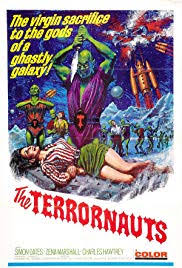
The Terrornauts (Montgomery Tully, 1967)
(Please note: this post was supposed to be up on the weekend of the 14th to the 16th of June to be a part of the Hammer/Amicus Blogathon, and is thus of course five weeks overdue. Apologies for the glitch in the Matrix that led to me overshooting and emerging from the Vortex at this late set of Space-Time co-ordinates.)
Horror was not all Hammer, of course, in the Britain of the mid-1950s to the mid-1970s. While Hinds and Carreras' colossus bestrode the silver screen, seeming to rule over the genres of horror, science fiction and fantasy for those two decades there were other - admittedly smaller in stature - studios producing films for the fulfillment of the fandom (or "relish for the palate of a jaded motion picture public", as the publicity for the 1915 release of Paul Wegener's seminal titan of terror The Golem phrased it). Tempean Films, formed by producing duo Robert Baker and Monty Berman, produced a steady stream of dramas and thrillers before following in Hammer's wake with 1958's Blood of the Vampire (Henry Cass), Jack the Ripper (Berman and Baker), The Trollenberg Terror Quentin Lawrence) and 1960's The Hellfire Club (Berman and Baker) - the duo would then team with writer-director John Gilling to form Triad Films in order to make Gilling's 1960 retelling of the infamous bodysnatchers Burke and Hare in The Flesh and the Fiends.
Tony Tenser's Tigon British Productions maintained an output of horror/sci-fi movies from the late 1960s, such as Michael Reeves' superlative twin-spin of 1967's The Sorcerers and 1968's Witchfinder General, Vernon Sewell's 1968 The Blood Beast Terror and Curse of the Crimson Altar, The Haunted House of Horror (Michael Armstrong, 1969), Blood on Satan's Claw (Piers Haggard, 1971) and The Creeping Flesh Freddie Francis, 1973). Tom Blakeley's Planet Film Productions gave the world the 1965 Devils of Darkness (the final film to be helmed by the prolific Lance Comfort), and the 1966 and 1967 Terence Fisher directed duo Island of Terror and Night of the Big Heat. Former Hammer lenser Freddie Francis formed Tyburn Films in the mid-70s with his son Kevin Francis, releasing The Ghoul and Legend of the Werewolf in 1975.
But the main rival to Hammer for the crown of British cinema's kings of the cinefantastique was Amicus. Formed by New Yorkers Milton Subotsky and Max J Rosenberg, Amicus (from the Latin for 'friends') started out with an output such as the pop music showcases It's Trad, Dad! ([aka Ring-a-Ding Rhythm] Richard Lester, 1962) and Just for Fun (Gordon Flemyng, 1963) before forsaking the popular beat hits of the likes of Helen Shapiro, Craig Douglas and Bobby Vee to sow their seed in a darker vein.
Amicus would become famous among the Among-We of the Famous Monsters of Filmland for their refinement of the portmanteau horror film, producing such winners as Freddie Francis' Dr Terror's House of Horrors (1965), Torture Garden (1967) and Tales from the Crypt (1972), The House That Dripped Blood (Peter Duffell, 1970) and Roy Ward Baker's Asylum (1972) and The Vault of Horror (1973). Betwixt these devilish delights, however, they would keep up a varied roster of drama, fantasy and science fiction - and it is to the latter category that we turn. I believe i first came across The Terrornauts (not literally, don't be disgusting) whilst perusing a piece on the rather splendiferous website wearecult.rocks by the reliably brilliant Dr Laura Mayne (which i recommend checking out, if you have the time or inclination) which included some of the original wishful-thinking concept art for the film and contrasted them with the rather tragically mundane realisation in reality. Being then - in the wise, wise words of Go West - the king of wishful thinking (just in general, rather than to do with Dr Mayne herself) and cognisant with the feeling of dreams hitting bland reality with an ecky thump, of course i thought it looked well worth investigating.
Opening at the headquarters of Project Star Talk - very much the British 1950s/60s British Rocket Group lash-up "make do and mend" version of SETI - we are introduced to our core cast of the intrepid Dr Joe Burke (Simon Oates) and his trusty companions Ben Keller (Stanley Meadows) and Sandy Lund (Zena Marshall), who are striving to make radio contact with intelligences beyond the surly bonds of Earth whilst being hampered by the hectoring and overexpectant of results Dr Henry Shore (Max Adrian, previously the vampire doctor [not the vampire Doctor - that's Jon Pertwee in House That Dripped Blood] in Amicus' previous Dr Terror). Dr Shore's lack of belief in Burke's project and constant demand for results ("It better happen in the next three months!") builds to his threat to close down the project for good.
After staring wistfully at a painting of an eerie alien landscape that he's - rather egocentrically, really: how many people hang a painting they did as a schoolkid in their workplace? - hang on the lab wall signed and dated 'JOE BURKE, 1940', Burke (and hair, standing on end) begins receiving a signal. A steady, repeated signal from outer space that he swears he finds familiar. He relates, in flashback, a tale of his childhood when his archaeologist uncle, on a dig in southern France (something in le Cro-Magnon, perhaps?) discovered amidst the bones of bygone ages a strange black box. This cosmic cube not being found an objet of historical significance, it was given to young Joe, who began to experience strange dreams (as we all do when young) of an extraterrestrial planetscape - complete with binary moons that wheel in the alien sky. And dodgy matte work that ensures that the smoke from volcanic eruptions on the surface pass behind one of said planetary bodies. Oh dear. Even my dreams have a better effects budget than this. Yet it was this childhood dream that led him to be a doctor, on his stellar search for speech from Spock.
"This will cause a sensation!" cries Charles Hawtrey (a phrase he may well have used off-screen in his down[low]time) as the officious auditor Joshua Yellowlees, sent to check the project's accounts as they transmit their reply to the signal's source. As they do so, a rather wobbly robot slightly resembling Lucifer from the original Battlestar Galactica if he'd been built by some drunken Robot Wars contestants jerks into life within the asteroid. It (let's not presume the gender of a dodgy droid) triggers the launch of an extremely poor model - sorry, a spaceship, which follows the transmissions from the satellite heart and beams up the entire project (including Burke, Keller, Lund, Yellowlees and gossipy tea lady Mrs Jones [Patricia Haines]). More than three feet high and rising, Joe tries to reason out their perilous situation as they head towards the suspiciously hospitable asteroid in artificial gravity, whilst Mr Yellowlees cries "Mrs Jones!" as if some hybrid 'twixt Frank Darien from Hellzapoppin' and Leonard Rossiter from Rising Damp.
Summoned before Rubbish!Lucifer (or maybe it's a bit more like the robot from Logan's Run... something Seventies, either way), our leads are handed a box that isn't a bomb ("They always ticks before they explodes" as Mrs Jones so sagely informs us) containing food like rewarded lab rats in an experiment before being ushered into a bizarre series of tests like Takeshi's Castle meets The Crystal Maze on crack. Given another black box with which to ride on time, Joe goes back, back to his beginnings - to the strange new world of his adolescent dreams to encounter some green shower cap-clad lads who are a bit sacrifice-happy. Paradise ain't half as nice as it might seem. Finally receiving what the aliens are trying to transmit, scales fall from Burke's eyes in a blinding flash of knowledge of an interstellar war and the deathbed pleas of a dying race to stop the Enemy from space (but not the Enemy from Space, that'd be breaking Hammer's copyright).
Imagine the climax of Blake's 7 season two cliffhanger 'Star One' enacted, with the ragtag team of heroic humans facing down the intergalactic alien invasion fleet comprised of the guy from Doomwatch, a Bond girl, that one guy, a charlady and Charles bloody Hawtrey off the Carry Ons.
What?
Yes. Exactly.
Carry On Contact. It's not 2001, but it's tons of fun.
Monday, 29 April 2019
Telephone Time: The Vestris (Arthur Hiller, 1958)
In which we journey, like an ailing John Sheridan and a concerned Ood Elder, to peel back and peer beyond The Veil...
The list of television anthology series is quite a long one, even if one restricts oneself to those whose remit is to dabble in the arena of the unearthly or the bizarre. Famous examples abound, such as Tales of Tomorrow (1951-1953), Rod Serling's legendary The Twilight Zone (1959-1964) and the more sci-fi oriented The Outer Limits (1963-1965) - not to mention HBO's long-running EC Comics-inspired ghoulishly cackling Tales from the Crypt (1989-1996). From 1961 to 1963 watchers of US network NBC would witness horror legend Boris Karloff hosting tales of suspense and the supernatural in Thriller, but little did these enraptured viewers know that the erstwhile Mr Pratt was not a novice in the art of introducing a selection of eerie vignettes - as he had, three years earlier, filmed a very similar series entitled The Veil wherein he would also perform the duties of host and occasional guest star. But their ignorance of this occurrence can be forgiven, because by the caprice of fate The Veil had - like its title suggests - remained shrouded in mystery, unseen and forgotten. Falling victim to behind the scenes strife and the collapse of a financing deal, not enough episodes were completed before production was forced to shut down to sell to any network or put into syndication run. Therefore Karloff's The Veil dwelt in darkness, save for a selection episodes that were edited together into a trilogy of portmanteau TV movies (Jack the Ripper, Destination Nightmare and the eponymous The Veil respectively) until its rediscovery in the 1990s and subsequent (long delayed) release to the public on DVD.
The series itself started as something of a spin-off: the 'pilot episode' (entitled 'The Vestris') was actually produced as the twenty-fifth episode of the third season of Telephone Time (produced, like The Veil, by Hal Roach Studios and a shining example of 1950s US television's wanton display of corporate sponsorship - with its opening intro of "The Bell Telephone System presents..." - like other shows of the era such as The Philco Television Playhouse, The Alcoa Hour and General Electric Theater all proudly wearing their sucking of the corporate schlong of The Man proudly on their sleeves). The episode was introduced, as usual, by 'Dr Research' himself Professor Frank Baxter (also the host/narrator of 1956's Our Mr Sun and the US airings of the groundbreaking 1961 15-part Shakespeareathon An Age of Kings), who informs the viewer that the story was "first written down by a distinguished American of the 19th century", the Glasgow-born writer, diplomat, politician, Spiritualist and social reformer Robert Dale Owen.
The episode unfolds upon the titular barque Vestris, embarking upon an Atlantic voyage from "Plymouth, Ingerland" in Dr Baxter's words (PLYMOUTH: 1828!) to Boston in the spring of the eighteen-twenties. The crew of mostly British and Irish expatriate actors - including Torin Thatcher (soon to be a star of such genre classics as the Nathan Juran-helmed twin spin The Seventh Voyage of Sinbad [1958] and Jack the Giant Killer [1962]) as skipper Robert Norrich - lend a feeling of verisimilitude to proceedings talking place on a Culver City soundstage. An exception is the captain's wife, Mary Norrich. Played by New Orleans actress Rita Lynn, Mrs Norrich's accent seems to be in roughly the same mid-Atlantic position as the ship - which, coupled with some oddly out of place archaisms in the dialogue ("'Tis nothing!" for example) for the 1820s, gives the impression of an Amish theatre troupe mounting a performance. Still, co-star Tommy Duggan would later even the scales by putting on a pretty dreadful American accent as the unfortunate Senator Alcott in the 1971 Doctor Who story 'The Mind of Evil' in which he dies wearing a frankly horrible dressing gown - so perhaps Ms Lynn wins out in the end.
Mrs Norrich is suffering from a melancholy mal de mer during the voyage, haunted by voices from the lonely sea ("Even in my dreams, i hear them...") that make her certain that some disaster is looming on the horizon. Her Cassandra-like utterings dismissed by her husband as the idle fancies of a mind bored by "the monotony of seeing nothing but water" and that she should gain her "sea mind" along with her sea legs, Mrs Norrich is pushed further into embarking upon a voyage to Freak-Out City when she retreats to her cabin only to be confronted by a silent spectral harbinger (Karloff the Uncanny himself). Collapsing in fright, some deck hands rush to her aid and her husband enters to find his wife sprawled exhausted on the floor and surrounded by seamen. Finding no sign of the tall and thin mysterious stranger of whom she speaks ("His face was like that of death!"), Cap'n Norrich grows more convinced of his wife's bourgeoning hysteria until he notices the words Turn North West have been scrawled upon a chalk slate by some unknown hand - prompting a search for a stowaway on board.
Mary's nights of sleep continue to be plagued by signs and portents, as voices urge her to convey the message that the ship should stab northwestwards, driving her to wander the ship's fog-shrouded deck at night in her nightgown like a ghost and pleading with her husband to change course. "There's something at work here, some power beyond our understanding!" she argues when Norrich refuses to take the ship into the Arctic ice floes, before giving in to a spouse Guided by Voices and serving asManos the hands of fate much the the chagrin of his increasingly restless and mutinous crew. The ship eventually chances upon the stranded survivors of the iceberg-wrecked Morning Star - "We were on that ice for a week," says Robbins, "God knows how you found us - it was a miracle!" - and one of the rescued mariners happens to be the sunken ship's surgeon Dr Pierre, played by Boris Karloff, who pays a visit to the bedside of the now delirious Mrs Norrich, bedridden with intestinal fever. Lucky Pierre (ahem) was there. "I knew you would come!" she cries upon beholding the visage of the man she had beheld as a phantom, who reciprocates his life being saved by administering to the stricken psychic.
A slight but intriguing tale of interwoven destinies and ominous omens that prove to be blessings in disguise, 'The Vestris' is a worthwhile half hour of vintage 1950s television that i'm glad finally emerged from the oubliette of the forgotten to be enjoyed. Hello, sailor.
The list of television anthology series is quite a long one, even if one restricts oneself to those whose remit is to dabble in the arena of the unearthly or the bizarre. Famous examples abound, such as Tales of Tomorrow (1951-1953), Rod Serling's legendary The Twilight Zone (1959-1964) and the more sci-fi oriented The Outer Limits (1963-1965) - not to mention HBO's long-running EC Comics-inspired ghoulishly cackling Tales from the Crypt (1989-1996). From 1961 to 1963 watchers of US network NBC would witness horror legend Boris Karloff hosting tales of suspense and the supernatural in Thriller, but little did these enraptured viewers know that the erstwhile Mr Pratt was not a novice in the art of introducing a selection of eerie vignettes - as he had, three years earlier, filmed a very similar series entitled The Veil wherein he would also perform the duties of host and occasional guest star. But their ignorance of this occurrence can be forgiven, because by the caprice of fate The Veil had - like its title suggests - remained shrouded in mystery, unseen and forgotten. Falling victim to behind the scenes strife and the collapse of a financing deal, not enough episodes were completed before production was forced to shut down to sell to any network or put into syndication run. Therefore Karloff's The Veil dwelt in darkness, save for a selection episodes that were edited together into a trilogy of portmanteau TV movies (Jack the Ripper, Destination Nightmare and the eponymous The Veil respectively) until its rediscovery in the 1990s and subsequent (long delayed) release to the public on DVD.
The series itself started as something of a spin-off: the 'pilot episode' (entitled 'The Vestris') was actually produced as the twenty-fifth episode of the third season of Telephone Time (produced, like The Veil, by Hal Roach Studios and a shining example of 1950s US television's wanton display of corporate sponsorship - with its opening intro of "The Bell Telephone System presents..." - like other shows of the era such as The Philco Television Playhouse, The Alcoa Hour and General Electric Theater all proudly wearing their sucking of the corporate schlong of The Man proudly on their sleeves). The episode was introduced, as usual, by 'Dr Research' himself Professor Frank Baxter (also the host/narrator of 1956's Our Mr Sun and the US airings of the groundbreaking 1961 15-part Shakespeareathon An Age of Kings), who informs the viewer that the story was "first written down by a distinguished American of the 19th century", the Glasgow-born writer, diplomat, politician, Spiritualist and social reformer Robert Dale Owen.
The episode unfolds upon the titular barque Vestris, embarking upon an Atlantic voyage from "Plymouth, Ingerland" in Dr Baxter's words (PLYMOUTH: 1828!) to Boston in the spring of the eighteen-twenties. The crew of mostly British and Irish expatriate actors - including Torin Thatcher (soon to be a star of such genre classics as the Nathan Juran-helmed twin spin The Seventh Voyage of Sinbad [1958] and Jack the Giant Killer [1962]) as skipper Robert Norrich - lend a feeling of verisimilitude to proceedings talking place on a Culver City soundstage. An exception is the captain's wife, Mary Norrich. Played by New Orleans actress Rita Lynn, Mrs Norrich's accent seems to be in roughly the same mid-Atlantic position as the ship - which, coupled with some oddly out of place archaisms in the dialogue ("'Tis nothing!" for example) for the 1820s, gives the impression of an Amish theatre troupe mounting a performance. Still, co-star Tommy Duggan would later even the scales by putting on a pretty dreadful American accent as the unfortunate Senator Alcott in the 1971 Doctor Who story 'The Mind of Evil' in which he dies wearing a frankly horrible dressing gown - so perhaps Ms Lynn wins out in the end.
Mrs Norrich is suffering from a melancholy mal de mer during the voyage, haunted by voices from the lonely sea ("Even in my dreams, i hear them...") that make her certain that some disaster is looming on the horizon. Her Cassandra-like utterings dismissed by her husband as the idle fancies of a mind bored by "the monotony of seeing nothing but water" and that she should gain her "sea mind" along with her sea legs, Mrs Norrich is pushed further into embarking upon a voyage to Freak-Out City when she retreats to her cabin only to be confronted by a silent spectral harbinger (Karloff the Uncanny himself). Collapsing in fright, some deck hands rush to her aid and her husband enters to find his wife sprawled exhausted on the floor and surrounded by seamen. Finding no sign of the tall and thin mysterious stranger of whom she speaks ("His face was like that of death!"), Cap'n Norrich grows more convinced of his wife's bourgeoning hysteria until he notices the words Turn North West have been scrawled upon a chalk slate by some unknown hand - prompting a search for a stowaway on board.
Mary's nights of sleep continue to be plagued by signs and portents, as voices urge her to convey the message that the ship should stab northwestwards, driving her to wander the ship's fog-shrouded deck at night in her nightgown like a ghost and pleading with her husband to change course. "There's something at work here, some power beyond our understanding!" she argues when Norrich refuses to take the ship into the Arctic ice floes, before giving in to a spouse Guided by Voices and serving as
A slight but intriguing tale of interwoven destinies and ominous omens that prove to be blessings in disguise, 'The Vestris' is a worthwhile half hour of vintage 1950s television that i'm glad finally emerged from the oubliette of the forgotten to be enjoyed. Hello, sailor.
Wednesday, 17 April 2019
Re-Penetrator (Doug Sakmann, 2004) [NSFW]
Gettin' carnal amidst the charnel
I suppose i've come to terms over the years with the fact that i have something of an obsessive personality (and i'm not talking about the embarrassing time that a woman asked me to stop PMing her multiple times a week on Facebook, as she was having more conversations with me than with her family or boyfriend - though i guess i have just embarrassed myself by remembering and mentioning that fact). I suppose a large majority of cult and genre fans are, to some extent - the addiction to collecting, cataloguing, making lists and so on. We all, perhaps, have fandoms and obsessions that we don't really admit to others: a particular one of mine for the past couple of years has been perusing the oeuvre of Joanna Angel (is that a euphemism? I guess).
The multi-talented performer/writer/director/producer first caught my eye when i saw a film entitled Evil Head (a naughty affectionate lampooning of horror classic The Evil Dead) a few years ago. The realm of the pornographic parody has, in recent years, been mostly dominated (that's not a euphemism) by the superhero genre, but here i was discovering a very sexy goth/punk actress making sexy parodies of horror movies. Obviously, i was in love at first sight intrigued.
Parodying Stuart Gordon's goretastic 1985 filmic adaptation of HP Lovecraft's Re-Animator, Re-Penetrator is a 22 minute (pretty much an ideal length for the intent of it's content, really) short by Doug Sakmann (writing, directing, editing and supplying the [quite good] blood and gore effects under the nom de porn of The Evil Carrot) featuring in its two-hander (now there's a double meaning for you) cast Tommy Pistol taking Jeffrey Combs' manic performance as Dr Herbert West to the ne plus ultra as 'Dr Hubert Breast and Joanna Angel as 'Corpse Girl'. Lit with appropriately crepuscular green gels that make the endeavour seem like an X-rated Mario Bava film, Dr Breast beavers away (well, not yet, he's working at the beginning...) in his mortuary/laboratory filled with steaming and bubbling beakers of yer average mad scientist kind of set-up and pulls away the sheet from his morgue slab to reveal the naked form of the Corpse Girl, dressed - of course, as i suppose most dead people are - in nothing but a pair of stripper heels. I would pause here to muse whether it's mentally healthy or not to find a naked woman attractive even when she's playing dead and made up with autopsy stitches, but i didn't want to overly worry myself.*
"Prometheus brought the gift of life - fire to man" mugs the manic doctor, showing his knowledge of both Classical mythology and the Shelleyan source of Lovecraft's story. "But I - I will bring the world a much greater gift: immmmmortality!", followed by a 'nyah-ha-ha-haaa!' cackle that would make Skeletor jealous. Preparing his resurrection serum (the same lurid luminescent green as in Re-Animator, or even Dr Alec Holland's bio-regeneration formula from Swamp Thing), Dr Breast forgoes and ordinary hypodermic for a large artificial insemination syringe - injecting the potion straight up the subject's cervical canal.
"Unlike the other failures before you, who only craved the brain," the alchemical coot croons to his creation, "you - with the help of this serum- you, my darling, will crave sex!"
And he's not wrong, you know. No sooner is the dearly departed doxy sitting up and breathing than she is treating the Maker to an eager spot of thanatological fellatio, consisting of Ms Angel obviously holding a mouthful of Kensington Gore (is that what we still call movie blood? All my reference books are out of date) and spitting it over the shaft during the act. Which i found quite effective. I mean, what is life in the end but flesh and blood and sex and death? And here we have it all - not least when we progress through the positions (ooh - from behind with some throat holding: there's nice. Though logistically you probably can't choke-fuck a corpse) and end up with some cunnilingus on the delectable corpus de-lick-ti that ends up with her shuddering out the words "I'm gonna cum all over your face!" and then some very effective gore effects as she spurts gouts of vaginal blood over the lapping lab rat. Why not play along at home during your partner's time of the month, dear readers?
It all ends - as everything does - when the spent scientist finds himself being continually pawed at by his unsated opus until she mounts him again even more hungrily, biting and clawing at him as rides him in the cowgirl position, blood and guts and sweat and other bodily fluids flying. It's how i want to go, for sure.
I guess that even in the hellish environment of a charnel house, it's heaven when an Angel is present.
(*And besides - if i can continue to cope with the fact that i once had a conversation in the University bar that consisted of someone asking me if i discovered the body of an attractive woman "and she was still warm", would i consider necrophilia to be okay - then i can cope with anything. The man who was emitting these opinions went on to be jailed for taking a weapon into the drama studio one day and holding everyone to ransom. I state this simply as a matter of historical record, rather than drawing a specific correlation between events.)
Parodying Stuart Gordon's goretastic 1985 filmic adaptation of HP Lovecraft's Re-Animator, Re-Penetrator is a 22 minute (pretty much an ideal length for the intent of it's content, really) short by Doug Sakmann (writing, directing, editing and supplying the [quite good] blood and gore effects under the nom de porn of The Evil Carrot) featuring in its two-hander (now there's a double meaning for you) cast Tommy Pistol taking Jeffrey Combs' manic performance as Dr Herbert West to the ne plus ultra as 'Dr Hubert Breast and Joanna Angel as 'Corpse Girl'. Lit with appropriately crepuscular green gels that make the endeavour seem like an X-rated Mario Bava film, Dr Breast beavers away (well, not yet, he's working at the beginning...) in his mortuary/laboratory filled with steaming and bubbling beakers of yer average mad scientist kind of set-up and pulls away the sheet from his morgue slab to reveal the naked form of the Corpse Girl, dressed - of course, as i suppose most dead people are - in nothing but a pair of stripper heels. I would pause here to muse whether it's mentally healthy or not to find a naked woman attractive even when she's playing dead and made up with autopsy stitches, but i didn't want to overly worry myself.*
"Unlike the other failures before you, who only craved the brain," the alchemical coot croons to his creation, "you - with the help of this serum- you, my darling, will crave sex!"
And he's not wrong, you know. No sooner is the dearly departed doxy sitting up and breathing than she is treating the Maker to an eager spot of thanatological fellatio, consisting of Ms Angel obviously holding a mouthful of Kensington Gore (is that what we still call movie blood? All my reference books are out of date) and spitting it over the shaft during the act. Which i found quite effective. I mean, what is life in the end but flesh and blood and sex and death? And here we have it all - not least when we progress through the positions (ooh - from behind with some throat holding: there's nice. Though logistically you probably can't choke-fuck a corpse) and end up with some cunnilingus on the delectable corpus de-lick-ti that ends up with her shuddering out the words "I'm gonna cum all over your face!" and then some very effective gore effects as she spurts gouts of vaginal blood over the lapping lab rat. Why not play along at home during your partner's time of the month, dear readers?
I guess that even in the hellish environment of a charnel house, it's heaven when an Angel is present.
(*And besides - if i can continue to cope with the fact that i once had a conversation in the University bar that consisted of someone asking me if i discovered the body of an attractive woman "and she was still warm", would i consider necrophilia to be okay - then i can cope with anything. The man who was emitting these opinions went on to be jailed for taking a weapon into the drama studio one day and holding everyone to ransom. I state this simply as a matter of historical record, rather than drawing a specific correlation between events.)
Subscribe to:
Posts (Atom)